
Haunted place · Alabama, United States
Newton, Alabama
Updated November 20269 sourcesHow to visit
- 5 archive documents
Newton, Alabama, where the Home Guard hanged minister Bill Sketoe in 1864 and legend says the hole dug beneath his feet refused to stay filled for decades.
The story
Newton is a small farming town in Dale County, in the Wiregrass region of southeastern Alabama, with 1,607 residents at the 2020 census. Its haunted reputation does not belong to the town as a whole. It rests on a single story: a hanging on the Choctawhatchee River in the last winter of the Civil War, and a hole in the ground that, according to local tradition, refused to stay filled.
The town itself grew out of county politics. When Coffee County was carved from the western half of Dale County, the old seat at Daleville found itself far from the center of what remained. A new seat was established, and in 1843 it took the name Newton. During the Civil War the town served as a Confederate recruiting point. In March 1865 it saw fighting: a column of the 1st Florida Cavalry, a Union regiment operating out of Florida, rode in intending to burn the courthouse. It was led by Joseph Sanders, a Dale County man who had served as a Confederate captain in the 31st Georgia Infantry before changing sides. Local Home Guard troops ambushed the column as it entered town and drove it off. A downtown monument and annual reenactments still mark the fight.
Three months earlier, on December 3, 1864, the same Home Guard had hanged William "Bill" Sketoe just north of town. Sketoe, born in 1818, was a Methodist minister and the husband of Sarah Clemmons. Tradition says he was born in Madrid, Spain, though other accounts place his birth in South Carolina. The guardsmen were commanded by Captain Joseph Breare, whose name is also spelled Brear. The legend has Breare accusing Sketoe of desertion, but no record shows that Sketoe ever served in a Confederate unit, so there was nothing to desert from. Historian David Williams, in his 1999 book Rich Man's War, suggests the real suspicion was that Sketoe was helping John Ward, a pro-Union guerrilla active in the area; no firm evidence for that was ever produced either. The Encyclopedia of Alabama describes the killing as a wrongful hanging. Sketoe was buried at Mt. Carmel Cemetery under the epitaph "gone, but not forgotten."
After the war Newton's importance faded. The courthouse burned in March 1869, and when Geneva County was formed (1868 per the Encyclopedia of Alabama, 1870 per Wikipedia) from the southern parts of Dale and Coffee, voters chose the more central town of Ozark as the new seat; the move was completed in 1871. Newton incorporated in 1887. The Southern Star newspaper was founded here in 1867 before relocating to Ozark, where it is still published. Riverboats called at Newton on the Choctawhatchee until the railroad arrived in 1890, and the Baptist Collegiate Institute operated in town from 1898 until 1929 or 1930. Its main building is now the public library.
The legend
The story of Sketoe's hole is less a ghost story than a tale of a mark that would not go away. Sketoe was a tall man. When he was strung up from a tree by the river, the branch bent under his weight and his feet reached the ground, so his executioners scooped out a hole beneath him to finish the job. Over the following decades, the legend says, that hole, described as roughly 30 inches across and 8 inches deep, stayed clean and empty no matter how often people filled it with dirt or debris. Locals called it "the hole that won't stay filled," and many treated it as a sign that an innocent man had been put to death.
There is no classic apparition at the heart of the tradition. No figure in a minister's coat is said to walk the riverbank. The haunting is the hole itself, and the sense that the ground was keeping a record of an injustice. Visitors and paranormal researchers still stop at the site, though no named investigation group or television episode has been documented for it.
The legend reached a wide audience through Kathryn Tucker Windham, the Alabama storyteller who wrote 13 Alabama Ghosts and Jeffrey with Margaret Gillis Figh in 1969. That book remains the main written source for the tale and fixed it in the state's folklore alongside her other Alabama hauntings.
Not everyone accepted the supernatural reading. One local woman claimed that friends of Sketoe quietly cleaned out the hole to keep his memory alive; another resident denied that anyone had done so. Both versions survive, and nobody can now test either one. What is solid is the history underneath: a minister was hanged without trial by a local militia, on an accusation that the records do not support. The legend tends to frame his killing as a miscarriage of justice, and historian David Williams found no evidence for the accusation, though that is no reason to think the earth itself took his side.
What remains today
The original hole is gone. In 1979 a new highway bridge was built over the hanging site and tons of rip-rap, the loose rock used to protect riverbanks, were placed around it. After the 1990 flood the spot was buried under rock; the Encyclopedia of Alabama says the flood destroyed the site outright and that the town then built a replica hole on the riverbank.
In 2006 Sketoe's descendants and town officials dedicated a monument near the place where he died. Newton's town museum keeps a collection of Sketoe memorabilia, and his grave at Mt. Carmel Cemetery still carries its short epitaph. In town, a separate monument recalls the March 1865 fight against the Union raiders, and the former Baptist Collegiate Institute building now serves as the public library.
Visiting
The Sketoe site is a public roadside spot near the Choctawhatchee River bridge just north of town, with the 2006 monument and the replica hole. It can be seen freely; take care near the road and stay off the rip-rap and away from the water.
To get the fuller story, look for the Sketoe memorabilia displayed by the town museum, and if you visit the grave at Mt. Carmel Cemetery, treat it as what it is, the burial place of a man whose descendants still honor him. There is no organized ghost tour in Newton. The annual reenactment of the 1865 battle is another link to the town's Civil War past, and Windham's 13 Alabama Ghosts and Jeffrey is the best companion read before a visit.
The ghosts
Spirit
Bill Sketoe and the hole that won't stay filled
Said to be Rev. William "Bill" Sketoe (1818-1864), Methodist minister hanged by the Newton Home Guard
Sketoe was hanged by the local Home Guard in December 1864, and a hole was dug under his feet because he was too tall for the bending branch. Legend says the hole stayed clean and empty for decades no matter how often it was filled. No apparition is part of the core tradition; the hole itself is the haunting.
First reported: Oral tradition, date unknown; popularized in print in 1969. Reported by: Kathryn Tucker Windham and Margaret Gillis Figh, 13 Alabama Ghosts and Jeffrey (1969)
Photographs


Old maps


Where it is
The circle shows the general area only. Open on the full map
Sources
- Minutes of the thirty-first annual session of the Newton Baptist Association (Ala.) 1896 — Internet Archive · Newton Baptist Association, 1896-01-01 · Public domain (pre-1929)
- Wikimedia Commons category : Newton, Alabama — Wikimedia Commons
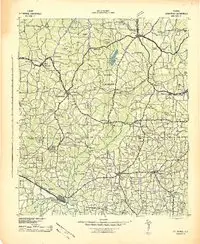
- USGS 1:125000-scale Quadrangle for Enterprise, AL 1942 — U.S. Geological Survey, 1942 · Public domain (USGS)
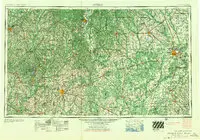
- USGS 1:250000-scale Quadrangle for Dothan, AL 1955 — U.S. Geological Survey, 1955 · Public domain (USGS)
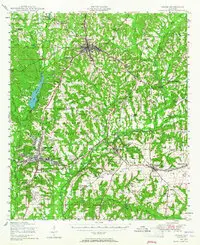
- USGS 1:62500-scale Quadrangle for Ozark, AL 1948 — U.S. Geological Survey, 1948 · Public domain (USGS)
- Bill Sketoe — Wikipedia — Wikipedia
- Kathryn Tucker Windham — Encyclopedia of Alabama — Encyclopedia of Alabama
- Newton — Encyclopedia of Alabama (Alabama Humanities Alliance / Auburn University) — Encyclopedia of Alabama (Alabama Humanities Alliance / Auburn University
- Wikipedia article — Wikipedia · CC BY-SA 4.0
Text written by AI from the sources above and checked by a separate AI fact-check (how we work). Images: credits and licenses under each picture.
Spotted a mistake? Report an error