
Haunted place · Alabama, United States
Dr. John R. Drish House
Updated November 20269 sourcesHow to visit
- Protected heritage
- 19 archive documents
1837 Greek Revival and Italianate mansion in Tuscaloosa, Alabama, whose tower is said to glow as if on fire with the funeral candles of Sarah Drish.
The story
The Drish House stands in Tuscaloosa's Southside neighborhood, about twelve blocks south of downtown, on an unusual circular lot from which streets radiate like spokes. It was built in 1837 as the home of Dr. John R. Drish, a physician and planter, and his family. The early design is usually credited to the architect William Nichols, and the house was built by enslaved artisans: Drish's craftsmen made the bricks by hand, and the stone capitals of the pilasters were carved by Drish's workmen.
The original house was a Greek Revival mansion of stuccoed brick, two stories tall, with a monumental portico on both its north and south fronts. Around 1860 to 1862, on the eve of the Civil War, it was remodeled in the fashionable Italianate style, gaining bracketed eaves and its signature feature, a three-story tower rising about 60 feet in the middle of the north facade. Inside, a celebrated double elliptical staircase curved up in two branches before joining in a single flight; it was replaced sometime before 1934. Alabama preservationists consider the result one of the most distinctive blends of Greek Revival and Italianate design in the state.
Local tradition remembers John Drish as a man with a taste for gambling and drink. He died in August 1867, reportedly after a fall down the stairs of his own house, an account the National Register nomination says cannot be verified. His widow, Sarah (born Sarah Owen McKinney), lived on until 1884. After her death the mansion passed through several owners, and its surrounding land was sold off and subdivided, becoming Tuscaloosa's first large suburban expansion.
The house then began a long series of second lives. The Tuscaloosa Board of Education opened the Jemison School in it in 1906, and classes continued until 1925. Next it served as a parts warehouse for the Tuscaloosa Wrecking Company, and it was in that shabby state that photographer Walker Evans captured it in 1935 or 1936, in an image now in the collection of the Metropolitan Museum of Art. The Historic American Buildings Survey had documented the house in 1934. In 1940 Southside Baptist Church bought the property, removed interior walls to create an auditorium and classrooms, restuccoed the exterior, built a sanctuary against one side and put up a separate Sunday school building on the other.
The congregation dwindled in the 1990s. Demolition was proposed in 1994, but former members arranged instead for the county's Heritage Commission to lease it, and the church itself folded in 1995. By 2006 the house was in such poor condition that the Alabama Historical Commission and the Alabama Trust for Historic Preservation put it on their "Places in Peril" list. The Tuscaloosa County Preservation Society received the deed in July 2007, stabilized the structure and removed the church additions in 2009. The property was sold to a private company in 2012, and after years of interior and exterior renovation it opened as an event venue in May 2016. It has been on the Alabama Register of Landmarks and Heritage since 1975 and joined the National Register in 2015, listed as the Jemison School.
The legend
The Drish House has one of the oldest and most specific ghost stories in Alabama. According to Wikipedia, hauntings have been reported there since the early 20th century, and the tale reached a wide audience in 1969, when Kathryn Tucker Windham and Margaret Gillis Figh included it in *13 Alabama Ghosts and Jeffrey*, a classic of Southern ghost lore, under the title "Death Lights in the Tower."
The story centers on Sarah Drish. When her husband died in 1867, the legend goes, she kept the candles that had burned at his funeral and insisted they be lit again at her own. When she died in 1884, nobody could find them, and her funeral went ahead without them. Ever since, people have reported seeing the third story of the tower apparently on fire, or strange lights shining from the house, though no fire is ever found. Locals explain the glow as Sarah, still angry, lighting her lost candles. The story is all the more striking because the top room of the tower cannot be reached by the main stairs, and its arched windows were bricked up early in the 20th century.
According to a member of the local paranormal group Southern Ghost Girls, quoted in the University of Alabama student newspaper *The Crimson White* in 2022, passersby still call 911 regularly believing the house is ablaze. That claim comes from a single source and has not been confirmed by the fire department.
John Drish has his own ghost story. Fittingly for a man said to have died after a fall on his stairs, the Southern Ghost Girls say he still walks them. During their investigation, members reported whispers, footsteps on the staircase, blinds that moved and tapping sounds. One investigator said she heard footsteps and was then pushed on the stairs, and that their equipment answered "yes" when asked whether she had been pushed. The group also described the area of the former church baptismal font as especially "responsive."
These later accounts come from enthusiasts rather than independent observers, and no skeptical investigation of the burning-tower story was found. Still, the core legend of Sarah's candles is well over half a century old in print and is part of Tuscaloosa's folklore.
What remains today
The restored house still occupies the center of its round lot. Its two colossal porticos with stuccoed brick columns, the hip roof with wide eaves, and the Italianate tower with brackets, egg-and-dart moldings and Ionic pilasters all survive. When it was nominated to the National Register, the interior still showed later changes, such as the 1940s oak floors laid over the original heart pine and the pre-1934 stairs that replaced the elliptical staircase; the property has since been extensively renovated for its new role. The National Register nomination judged that the building keeps its overall historic integrity.
Visiting
The Drish House is privately owned and operates as an event venue for weddings and parties. It is not a museum, and we found no ghost tours offered there; its official website does not mention the hauntings at all. Unless you are attending an event, please do not enter the grounds. The tower, the porticos and the round lot can be appreciated from the surrounding public streets of the Southside neighborhood. For the full legend, Kathryn Tucker Windham and Margaret Gillis Figh's *13 Alabama Ghosts and Jeffrey* is the classic telling.
The ghosts
Spirit
Dr. John R. Drish
Said to be Dr. John R. Drish, builder of the house, who died in 1867, reportedly after a fall on the stairs
A local paranormal group says the doctor still walks the staircase where he is said to have fallen. They reported whispers, footsteps, moving blinds, tapping, and one member said she was pushed on the stairs.
- Footsteps
- Voices
- Being touched
- Moving objects
Reported by: Southern Ghost Girls via The Crimson White (2022)
Sarah Drish and the death lights
Said to be Sarah Owen McKinney Drish (died 1884), widow of Dr. John R. Drish
Sarah is said to have saved the candles from her husband's funeral for her own, but they had vanished by the time she died. Since then, people report the third-story tower apparently burning or lights glowing in the house, explained locally as Sarah lighting her candles.
- Strange lights
First reported: early 20th century; in print 1969. Reported by: Kathryn Tucker Windham and Margaret Gillis Figh, 13 Alabama Ghosts and Jeffrey (1969); Southern Ghost Girls via The Crimson White (2022)
Photographs


From the archives


Old maps
Where it is
The circle shows the general area only. Open on the full map
Sources
- National Register nomination #14000357 (texte intégral) — U.S. National Park Service · Public record
- National Register of Historic Places file (NRHP #14000357) — U.S. National Park Service · Public domain (U.S. government)
- Wikimedia Commons category : Dr. John R. Drish House — Wikimedia Commons
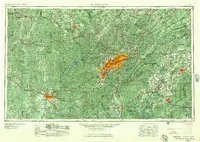
- USGS 1:250000-scale Quadrangle for Birmingham, AL 1957 — U.S. Geological Survey, 1957 · Public domain (USGS)
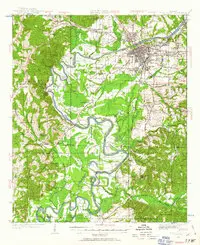
- USGS 1:62500-scale Quadrangle for Tuscaloosa, AL 1924 — U.S. Geological Survey, 1924 · Public domain (USGS)
- "13 Alabama Ghosts and Jeffrey" — Wikipedia (book: Windham & Figh, Strode, 1969). — Wikipedia (book: Windham & Figh, Strode, 1969).
- Historic Drish House — official event-venue site. — venue site.
- "'The history leaves an imprint on the land': The ghosts of Tuscaloosa past" — The Crimson White (Sarah Clifton, 30 Oct 2022). — The Crimson White (Sarah Clifton, 30 Oct 2022).
- Wikipedia article — Wikipedia · CC BY-SA 4.0
Text written by AI from the sources above and checked by a separate AI fact-check (how we work). Images: credits and licenses under each picture.
Spotted a mistake? Report an error