
Haunted place · Alabama, United States
Cahaba, Alabama
Updated November 20269 sourcesHow to visit
- Protected heritage
- 18 archive documents
Cahaba, Alabama's first permanent capital, was drowned by floods and deserted by 1900; its ruins hold a Civil War prison site and a ghostly orb in a vanished maze.
The story
Cahaba, which the state park spells Cahawba, sits in Dallas County, Alabama, southwest of Selma, on the point of land where the Cahaba River flows into the Alabama. That meeting of rivers gave the town its purpose and, in the end, destroyed it.
People lived here long before the capital. The Encyclopedia of Alabama notes a Mississippian-period village on the site and a Choctaw town in the early 1700s. The 1973 National Register nomination suggests it was probably Casiste, a village visited by Hernando de Soto's expedition in 1540, and possibly the spot of a short-lived early 18th-century trading post built for the French merchant Crozat, to whom Louis XV had granted the region.
The town's rise came with statehood. In 1818 a commission was appointed to pick a permanent capital. Historian William H. Brantley wrote that its members leaned toward Tuscaloosa, but Governor William Wyatt Bibb secured a federal grant of 1,620 acres and steered the choice to Cahaba. Dallas County was formed in 1818 and Cahaba became its seat in 1819. At the first land auction in May 1819, 182 lots sold for $123,856, and a two-story brick statehouse, 158 feet long, was ordered for June 1820. Huntsville served in the meantime, and the constitution made Cahaba permanent only if no rival was chosen within five years, a loophole north Alabama politicians intended to exploit.
Bibb died after a fall from his horse before the legislature first sat at Cahaba in November 1820. His brother and successor, Thomas Bibb, came from the Tennessee Valley and did not share his brother's commitment to the new town. Cahaba nevertheless grew quickly, housing the state Supreme Court and a state bank, and in 1825 it welcomed the Marquis de Lafayette on his American tour. That year a great flood inundated the town and part of the statehouse fell in. In January 1826 lawmakers voted to move the government to Tuscaloosa, citing floods and health. (Sessions were held at Cahaba from 1820 to 1825; the nomination counts the capital years as 1820-1826.)
Cahaba survived the loss. The old statehouse became the county courthouse in 1829 and was probably taken apart for materials after a new courthouse was built in 1834. After another flood in 1833, the town rebounded and in the 1840s and 1850s became a shipping hub for the cotton plantations of the Black Belt, sending bales down the Alabama River to Mobile. Planters and merchants built handsome two-story homes. The mansion of Edward Martineau Perine, merchant and planter, was said to be cooled by water from a 900-foot artesian well circulating through its walls, an early form of air conditioning. St. Luke's Episcopal Church, the work of Richard Upjohn, an architect of national reputation, went up in 1854, and a railroad from Marion reached town in 1859.
The Civil War left a darker mark. From 1863 to 1865 a riverside cotton warehouse served as Castle Morgan, a Confederate prison for captured Union soldiers. It held about 3,000 men when floodwaters swept through Cahaba in February 1865. After the Battle of Selma that April, the Union general James H. Wilson and the Confederate general Nathan Bedford Forrest met at the Crocheron house in town to negotiate an exchange of prisoners.
Why it was abandoned
Floods and politics finished the job. After the 1865 flood, Dallas County moved its seat to the better-placed town of Selma in 1866. Courts, lawyers and the businesses that served them left, and residents followed. By 1870 about 300 people remained according to the Encyclopedia of Alabama, or 431 by the census figure on Wikipedia. Wikipedia describes the decline as rapid, while the 1973 nomination speaks of a slow death; either way, by about 1900 Cahaba was a ghost town, and in the early 1900s its buildings were being dismantled and hauled away for their bricks and timber.
The legend
Wikipedia says the town, and later its empty site, produced many ghost stories over the 19th and 20th centuries, but it names only one, and that one is famous in Alabama. It concerns the home of C. C. Pegues, which took up a whole block between Pine and Chestnut streets and had a garden maze. The story tells of a glowing ball of light drifting along the paths of that maze.
The tale owes its fame to print. It appears as "Specter in the Maze at Cahaba" in 13 Alabama Ghosts and Jeffrey, written by Kathryn Tucker Windham with Margaret Gillis Figh and published by Strode Publishers in 1969. It was the first of Windham's much-loved ghost-story collections. We read nothing that dates the story itself, and 1969 is the earliest printed version found, and our sources give no named witnesses or dates of sightings. Both the Pegues house and its maze have vanished. No television investigation or named paranormal group is recorded for the site. Cahaba's power comes less from a documented haunting than from the scattered ruins and cemeteries of a capital that the rivers reclaimed.
What remains today
Very little of the town still stands. The 1973 nomination, covering about 353 acres, listed scattered survivors: part of the walls and a column of the 1849 Methodist church, left after a fire in 1954; the house of Judge William W. Fambro, still lived in at the time; the columns of the Crocheron mansion; old street markers; and a cemetery. The Alabama Historical Commission now manages the site as the Old Cahawba Archeological Park, and the state and local supporters are turning it into a complete interpretive park. St. Luke's Episcopal Church, moved away after the town's decline, has been returned to Old Cahawba, where a campaign is raising money to restore it.
Visiting
Old Cahawba is a public state historic site, so it can be visited legally; check the Alabama Historical Commission or park website for hours, fees and events before going. It lies in rural Dallas County, a short drive from Selma. Stay on roads and marked paths, leave ruins, artifacts and graves undisturbed, and remember that the site sits where two rivers meet and has a long history of flooding. No dedicated ghost tour was confirmed in our sources, so the park's own interpretive programs are the best way to hear the town's history and the story of the maze.
The ghosts
Spirit
The Specter in the Maze
A glowing orb was seen drifting through the maze in the garden of the C. C. Pegues home, which filled a block between Pine and Chestnut streets. Both house and maze are gone. The tale was popularized as 'Specter in the Maze at Cahaba' in 13 Alabama Ghosts and Jeffrey (1969).
- Strange lights
First reported: Earliest print version 1969 (Windham & Figh); story said to be 19th-century. Reported by: Kathryn Tucker Windham and Margaret Gillis Figh, 13 Alabama Ghosts and Jeffrey (1969)
Photographs


From the archives


Old maps
Where it is
The circle shows the general area only. Open on the full map
Sources
- National Register nomination #73000341 (texte intégral) — U.S. National Park Service · Public record
- National Register of Historic Places file (NRHP #73000341) — U.S. National Park Service · Public domain (U.S. government)
- Wikimedia Commons category : Cahaba, Alabama — Wikimedia Commons
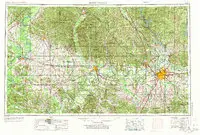
- USGS 1:250000-scale Quadrangle for Montgomery, AL 1953 — U.S. Geological Survey, 1953 · Public domain (USGS)
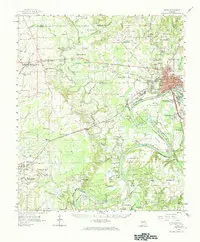
- USGS 1:62500-scale Quadrangle for Selma, AL 1958 — U.S. Geological Survey, 1958 · Public domain (USGS)
- Cahaba — Encyclopedia of Alabama — Encyclopedia of Alabama
- Kathryn Tucker Windham — Encyclopedia of Alabama — Encyclopedia of Alabama
- Official website
- Wikipedia article — Wikipedia · CC BY-SA 4.0
Text written by AI from the sources above and checked by a separate AI fact-check (how we work). Images: credits and licenses under each picture.
Spotted a mistake? Report an error