
Haunted place · Texas, United States
Jefferson Davis Hospital
Updated November 20268 sourcesHow to visit
- Protected heritage
- 2 archive documents
Houston's 1924 charity hospital, built over the old City Cemetery whose graves were never all moved, and a fixture of local ghost lore. Now artist lofts.
The story
Long before there was a hospital on this ridge in Houston's Historic First Ward, the land was the city's burying ground. Houston acquired it for $750 from a trust created by the Allen brothers, the city's founders, and from the 1840s it served as the municipal cemetery, divided into a potter's field, a commons, a section for Black burials and plots for families. Victims of yellow fever and cholera epidemics were buried here, and so were people who had been enslaved or freed, soldiers of both the Union and the Confederacy, and some of Houston's officials. Wikipedia puts the number of burials at more than 6,000.
The city stopped burying its dead here in 1879, though families continued to use their plots into the 1890s, and the cemetery then slid into neglect. In 1904 the city tried to sell the ground for industrial use, but Mayor A. L. Jackson vetoed the sale. When Houston decided in the 1920s to put a municipal hospital on the lot, a local chapter of the Sons of the Confederacy protested. The outcome was a ruling that nothing could be built over the Confederate section, and the new building was named after Jefferson Davis, president of the Confederacy, in a gesture meant to calm the objections. Most of the graves under the rest of the site were never relocated.
The hospital went up in 1924 and opened in 1924 or 1925 (sources differ). It was Houston's first centralized municipal hospital for indigent patients. The architects relied on high ceilings, long rows of large windows and an elevated position above a raised basement to catch sunlight and breezes, a design that saved on ornament and was meant to fight airborne disease. Screened balconies on the second and third floors let patients take the air without leaving the building, and a children's garden and playground occupied the roof.
Its life as a hospital was short. The main city services moved out in 1938 and 1939, and for the next half century Harris County used the building for a long list of purposes: records storage, a probation office, a convalescent home, a venereal disease clinic, a juvenile home, a food stamp office, drug treatment and plain storage. Part of the old cemetery was paved over for a city maintenance yard in 1968, and in 1986 construction work uncovered no fewer than 30 burials; they were plundered and left where they lay. The building was abandoned in 1989 and sat empty for sixteen years.
Rescue began in 2002. The city's Archeological and Historical Commission backed landmark status that March, and in June the county commissioners agreed to sell the building to Avenue Community Development Corporation and Artspace Projects of Minneapolis. Because the ground is a State Archeological Landmark, an archaeological survey had to precede any work so that graves would not be disturbed. Construction started on September 23, 2004, and the $6.3 million project, which included a $200,000 federal grant for removing asbestos, lead and an underground tank, turned the wards into the Elder Street Artist Lofts in 2005. Houston City Council made the building a protected city landmark on November 13, 2013.
The legend
The ghost stories here grow almost entirely out of what lies underneath. A hospital for the poor standing on thousands of unmoved graves was bound to attract tales, and its sixteen empty years did the rest. There is no famous named ghost. The spirits blamed for the reputation are, in a general way, the dead of the old City Cemetery.
Most of the specific sightings in print do not concern the hospital at all but a neighboring county building that housed the probation office. That building is said to have served as the hospital's morgue and to sit on Confederate graves. In an October 2001 Houston Press piece by Dylan Otto Krider, "They See Dead People", the earliest dated ghost article on record, a probation employee named Robert Hernandez, who belonged to a local investigation group, described what staff had experienced there: noises in the attic, a woman seen on upper floors that were supposedly unoccupied and are thought to have been a dormitory for the hospital's nurses, figures who walked into the ladies' restroom and were never seen coming out, and police dogs that would not go inside when a fire alarm sounded. These accounts rest on that single source.
The same article passed on a claim that dark patches of earth nearby were the graves of an English colony from the 1600s. We found nothing that supports that, and it should be treated as rumor. Another persistent story, that the building was once an insane asylum, is called false by Wikipedia, though the Houston Press says it housed a psychiatric ward at one stage; it probably comes from confusion with a different Jefferson Davis facility on Allen Parkway.
During the vacant years the old hospital became a place to break into on Halloween night for a free scare, and Senator John Cornyn's office described it as "a magnet for gangs and the homeless, as well as an attractive nuisance for youths." The danger was not supernatural. On July 31, 2003, a group of college students who had come looking for ghosts were robbed on the property, and the robbers fired shots, according to a KTRK television report cited by Wikipedia; nobody was hurt. The Houston Chronicle revisited "the haunted Jefferson Davis Hospital" in 2015, and the building also turns up in the 1990 film RoboCop 2. No ghost-hunting television episode is known to have been filmed here, and no detailed sighting reports from the lofts have surfaced since residents moved in.
What remains today
The restoration was supervised through the Texas Historical Commission and kept the overall layout of the interior. Plaster walls, the curved-corner interior window frames and the modillion blocks under the eaves were restored, and many exterior bricks were replaced and the walls repointed. Inside, the concrete ceilings were left bare, with new utility conduits running across them so the walls did not need to be altered. The rooftop where children once played was redone in asphalt close in color to the original tile. Artspace describes 34 live and work units for artists; the lead of the Wikipedia article gives 24.
Not everything survived. An unrestored building on the east side of the property burned in a two-alarm fire in 2013, during which a piece of burning tile fell on a firefighter. The two-story nurses' quarters, designed in the mid-1920s by city architect W. A. Dowdy, lost part of its roof in a January 2017 storm, was denied historic designation because of that damage, and the county put forward a demolition plan the same year; whether it was carried out is unclear. The old cemetery ground around the building remains a protected archaeological site.
Visiting
The former hospital is now a private residential building where artists live and work. It is not open for tours, and no ghost tour is known to include it. Please do not try to enter the building or wander the grounds: people's homes are inside, and the land around it holds graves that are protected by law.
You can see the exterior from the public street in Houston's First Ward. If you are drawn by the history rather than the ghost stories, the story of the City Cemetery and the people buried in it is the real heart of this place, and local historical organizations and the Houston Press archive articles from 2000 and 2001 are good places to start.
The ghosts
Spirit
The dead of the old City Cemetery
Said to be Unnamed people buried in Houston's municipal cemetery from the 1840s: epidemic victims, enslaved and formerly enslaved people, Union soldiers, Confederate veterans, city officials
The hospital's haunted reputation is generally blamed on the thousands of graves left under the site when it was built in 1924. No specific ghost is named, and no detailed sightings inside the hospital or the later lofts were found.
Reported by: Wikipedia; Houston Press
Shadow figure
Vanishing figures
Staff at the probation building said figures were seen entering the ladies' restroom and never coming back out. Single source.
- Apparitions
First reported: 2001. Reported by: Robert Hernandez, via Houston Press (Dylan Otto Krider, 2001)
Woman on the upper floors
A woman has been reported on the supposedly empty upper floors of the neighboring probation building, which is thought to have housed the hospital's nurses. The account comes from a probation employee quoted in the Houston Press.
- Apparitions
First reported: 2001. Reported by: Robert Hernandez, via Houston Press (Dylan Otto Krider, 2001)
Photographs


Old maps
Where it is
The circle shows the general area only. Open on the full map
Sources
- National Register of Historic Places file (NRHP #05000859) — U.S. National Park Service · Public domain (U.S. government)
- Wikimedia Commons category : Jefferson Davis Hospital — Wikimedia Commons
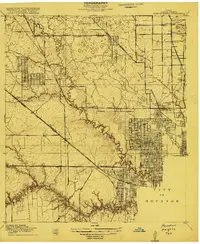
- USGS 1:24000-scale Quadrangle for Houston Heights, TX 1915 — U.S. Geological Survey, 1915 · Public domain (USGS)
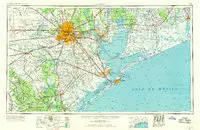
- USGS 1:250000-scale Quadrangle for Houston, TX 1956 — U.S. Geological Survey, 1956 · Public domain (USGS)
- Elder Street Artist Lofts — Artspace — Artspace
- Renovated Out of Existence — Houston Press (Brian Wallstin, 6 July 2000) — Houston Press (Brian Wallstin, 6 July 2000
- They See Dead People — Houston Press (Dylan Otto Krider, 18 Oct 2001) — Houston Press (Dylan Otto Krider, 18 Oct 2001
- Wikipedia article — Wikipedia · CC BY-SA 4.0
Text written by AI from the sources above and checked by a separate AI fact-check (how we work). Images: credits and licenses under each picture.
Spotted a mistake? Report an error