
Haunted place · Texas, United States
Central Unit
Updated November 202612 sourcesHow to visit
- 5 archive documents
Former Texas prison farm in Sugar Land built on a convict-leasing sugar plantation, closed in 2011 and probed by Ghost Adventures for inmate spirits.
The story
Long before it was a prison, the land around Sugar Land was a sugar plantation, and the men who cut its cane were often convicts. Starting in 1878, the State of Texas rented out prisoners to the owners of the Imperial Sugar property, Edward H. Cunningham and Littleberry A. Ellis, in exchange for a $75,000 payment. Within two years the partners held more than 1,000 convicts and were subleasing roughly 1,100 others to third parties. The arrangement was part of a system found across the post-Reconstruction South: states with few prisons of their own passed laws that criminalized minor behavior such as "vagrancy," and men who could not pay their fines were put to work for private operators. Oversight was minimal. Historian Theresa Jach has estimated that a leased convict on a sugar plantation could expect to live only about seven years. Douglas A. Blackmon's 2008 book *Slavery by Another Name* documents how this system worked across the region.
Texas bought the plantation outright in 1908, acquiring a little over 5,000 acres, and in April 1909 opened the Imperial State Prison Farm there, one of the first penal institutions the state actually owned. For decades it served as the hub of the prison system's agriculture. In 1930 it was renamed the Central State Prison Farm, the "Central" referring to its role as the collection and distribution point for crops grown across Texas correctional farms. A new $350,000 complex, paid for by the 41st Legislature, was finished in 1932: a concrete main building for administration and about 600 inmates, topped by a cupola that guards used as a lookout, plus an industrial building with a cannery, a meatpacking plant and a powerhouse. It replaced the wooden barracks of three older work camps.
Inmates at Central were segregated by race. In 1939 a separate Greek Revival brick dormitory known as Two Camp opened east of the Brazos River; it held as many as 400 young African-American prisoners, who slept in large wards called "tanks," until it closed in 1969 (the Houston Press gives 1968). In the mid-1930s the farm held nearly 700 men, and by the 1950s more than 1,000. In the early 1960s the unit took white first offenders under 25, while a second unit housed young Black repeat offenders.
As Sugar Land grew from a company town into an upscale suburb after 1960, the prison shrank. Parcels were sold to private buyers or handed to highway and school projects; a 1991 transfer for the Grand Parkway alone took about 3,700 acres, and by 2007 the unit was down to roughly 336 acres, with the runway of Sugar Land Regional Airport running between two parts of the property. In August 2011 the Texas Department of Criminal Justice announced that Central would close to save money during a budget crunch, the first Texas prison shut down without a replacement. The city was due to close on its purchase of the prison land on July 29, 2016.
The farm's past resurfaced in 2018, when construction of a school on former Imperial farm land uncovered 95 graves of convict laborers from the 1878-1911 leasing era. The "Sugar Land 95," as they became known, vindicated local advocate Reginald Moore, who had insisted for decades that leased prisoners were buried in the area. Those graves lay outside the Central Unit fence, but the prison grounds have their own burial ground for inmates whose families never claimed them.
The legend
Central Unit's ghost reputation is recent and thin, and it is worth being clear about that. Our sources contain no named ghost, no dated eyewitness account and no pre-closure tradition. The haunted label seems to have attached itself to the empty prison after it closed in 2011, and above all after television arrived.
That episode is *Ghost Adventures* Season 7, Episode 1, "Central Unit Prison," broadcast on the Travel Channel on September 14, 2012. Zak Bagans, Nick Groff and Aaron Goodwin billed themselves as the first investigators let inside after the closure, admitting they had "only a couple of stories" to work from. Their stated aim was to reach the spirits of the prison's violent former inmates, and the network's promotion mentioned suicides and "unexplained encounters" without describing any specific incident. The crew also stopped at the Texas Prison Museum in Huntsville for background. One online episode summary claims that more than 100 men died in the prison's electric chair; that appears to be a mix-up with the Huntsville Unit, where Texas carried out its executions, and nothing supports it for Central.
Beyond the show, the legend lives mostly among trespassers. Houston station KHOU reported that Sugar Land police were stepping up enforcement at the abandoned site, noting that many intruders were drawn by ghost hunting. A 2009 Houston Press article about the Two Camp building spoke of the "ghosts" of Black prisoners, but as a figure of speech about the building's history rather than a report of anything seen or heard.
What makes the place feel haunted, then, is not a particular apparition but its documented history: decades of convict leasing that killed men within a few years, a segregated prison farm, an unclaimed-inmate cemetery and, nearby, the 95 forgotten graves found in 2018. Readers should treat the paranormal claims as unverified and the human toll as real.
What remains today
The 1932 main building, with its lookout cupola, was designated a Recorded Texas Historical Landmark in 2003; as of 2016 it was to remain, so check its current state. While the prison shrank, much of the old farm became Telfair, a master-planned neighborhood whose developer bought state land in 2002 and began building around 2005; other parcels near the airport are zoned for light industry, and the city has studied converting much of its share into an industrial park.
Two Camp, empty for decades after 1969, was restored by the developer, given to the City of Sugar Land and leased to the Houston Museum of Natural Science, which spent about $3 million on renovation and opened its Sugar Land branch in the 43,000-square-foot building in 2009.
The prison cemetery was declared a Historic Texas Cemetery in 2007. It used to be open to visitors but is now enclosed by two fences, the inner one locked. A city park built around it with an encircling walkway was designed in 2012, but the bond measure to fund it failed in November 2013.
Visiting
As of 2016 the former prison buildings were city property and closed to the public, and the city planned to clear 96 of them. Sugar Land police patrol the site and have warned that trespassers will be arrested; ghost hunting is not an excuse. We found no ghost tours here.
The legal way to experience the place is the Houston Museum of Natural Science at Sugar Land, housed in the restored Two Camp dormitory. It is a natural science museum and does not promote ghost stories, but simply walking through a building that once held hundreds of young prisoners gives a sense of the site's past. For the wider story of the Texas prison system, the Texas Prison Museum in Huntsville is a dedicated institution. If you visit the area's historic cemeteries, remember that they hold people who died in forced labor or in custody, and behave accordingly.
The ghosts
Former inmates of Central Unit
The only ghost claim tied to the prison is generic: the Ghost Adventures crew set out to contact the spirits of violent former inmates, citing rumors of suicides and unexplained encounters. No specific apparition or witness is documented.
First reported: 2012. Reported by: Ghost Adventures (Travel Channel), S07E01
Photographs


From the archives

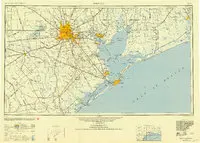
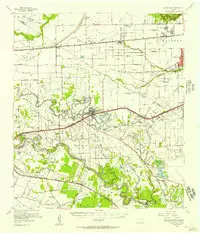
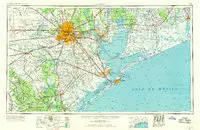
Old maps

Where it is
The circle shows the general area only. Open on the full map
Sources
- Wikimedia Commons category : Central Unit — Wikimedia Commons
- USGS 1:250000-scale Quadrangle for Houston, TX 1950 — U.S. Geological Survey, 1950 · Public domain (USGS)
- USGS 1:250000-scale Quadrangle for Houston, TX 1956 — U.S. Geological Survey, 1956 · Public domain (USGS)
- USGS 1:62500-scale Quadrangle for Sugar Land, TX 1955 — U.S. Geological Survey, 1955 · Public domain (USGS)
- "A Texas city discovered a mass grave of prison laborers…" (Andrea Roberts, 15 Aug 2018) — Texas A&M Today / The Conversation — Texas A&M Today / The Conversation
- "Central Unit prison" (6 Jul 2016) — Community Impact — Community Impact
- "From Black Prison To New Branch of The Houston Museum of Natural Science" (Richard Connelly, 13 Aug 2009) — Houston Press — Houston Press
- "Ghost Adventures 7x01: Central Unit Prison" — TVmaze — TVmaze
- "Ghost Adventures – Central Unit Prison" — TheTVDB — TheTVDB
- "Haunted Destination: Central Unit Prison" — Travel Channel (not read directly) — Travel Channel (page could not be fetched; search snippet only
- "Sugar Land PD cracking down on abandoned prison trespassers" — KHOU 11 (not read directly) — KHOU 11 (403 on fetch; search snippet only
- Wikipedia article — Wikipedia · CC BY-SA 4.0
Text written by AI from the sources above and checked by a separate AI fact-check (how we work). Images: credits and licenses under each picture.
Spotted a mistake? Report an error