
Haunted place · Texas, United States
Broadway Cemetery Historic District
Updated November 202610 sourcesHow to visit
- Protected heritage
- 2 archive documents
Seven historic cemeteries on Broadway in Galveston, Texas, said to be haunted by Nicaragua Smith, a Union turncoat shot by Confederates in 1863.
The story
The Broadway Cemetery Historic District is not one graveyard but seven, packed side by side into six city blocks along Broadway in Galveston, Texas, over about 15 acres. The oldest ground was platted in 1839, when Galveston was a young port of the Republic of Texas, and the complex kept growing for a century. According to the 2014 National Register nomination, it takes in the Old City Cemetery and the original Potter's Field (both 1839), the Episcopal (Trinity) Cemetery (1844), the Old Catholic Cemetery (about 1844), the Old Cahill or Yellow Fever Cemetery (about 1867), the Hebrew Benevolent Society Cemetery (about 1868), the New City and New Cahill cemeteries (about 1900), Evergreen (about 1923) and Oleander (1939).
Disease drove much of that expansion. Galveston, then the largest city in Texas and its main port of entry, was struck by yellow fever nine times in the 28 years from 1839 to 1867. In 1853 an estimated 60 percent of the population fell ill and 523 died; the last outbreak, in 1867, killed hundreds and sent thousands fleeing. A survivor later recalled that the sick died on the island "like sheep." A section of 42nd Street that once divided the burial grounds was closed and taken up by 1912, merging the grounds into one complex, and Avenue K was narrowed in 1926-28 to make room for more graves.
The cemeteries also bear the marks of the city's great engineering project. After the 1900 storm, Galveston raised its ground level, and the graves here were lifted two or three times, the last time in the 1920s, according to local historian Kathleen Maca. Markers were lost in the process, plots were resold, and in places the dead now lie in up to three layers. Maca counts roughly 12,000 visible markers and believes they represent only about a quarter of the burials; Wikipedia, by contrast, gives an estimate of about 6,000 burials as of 2014, so the true figure is uncertain. One striking result of the regrading is the mausoleum of state senator Franklin Merriman, buried up to its roof. Notable graves also include monuments to George Campbell Childress, William S. Fisher and John M. Allen, and the stone of longtime gravedigger Newton "Uncle Newton" Taylor, who died in 1905. National Register status came on June 13, 2014, and the district is still in use as a cemetery.
The legend
The ghost most often tied to these cemeteries is Thomas "Nicaragua" Smith, and his life is documented far better than his haunting. Probably a New Yorker by birth, he earned his nickname by joining William Walker's filibuster expedition to Nicaragua in 1856. Once the Civil War began, he slipped away from his post with a Confederate gun battery on Pelican Spit and signed up with the Union's 1st Texas Regiment. When the Union transport Cambria anchored off Galveston in January 1863, unaware the city had changed hands, he was sent ashore in a boat to fetch a pilot, recognized, tried by court-martial and executed by Confederate riflemen on January 8, 1863. He lies in an unmarked plot somewhere in the Old City Cemetery, and he reportedly asked to be buried face down.
The legend says that every January 8, on the anniversary of the execution, a voice screams through the sea fog, cursing the men who shot him. The story is best known from W. T. Block Jr.'s "Cannonball's Tales" column, republished in 2006, where Block credits the tradition to Galveston "old-timers" without naming any sources. A 2015 report by Houston's KPRC Channel 2 described Smith as the sole ghost attached to the cemeteries.
Commercial ghost tours tell a second, darker story. In 1894 Elize Roemer Alberti gave poison to her children. Four of them died; another lived through it, and one daughter was never poisoned. Newspapers of the day called her "the Demented Mother." She later took her own life and was buried in the same family plot. The tours count Alberti among the cemetery's haunted hosts, but no specific sighting or named witness has been found. Ghost-tour marketing also mentions roaming Confederate soldiers and yellow fever victims and ghosts in the Evergreen and New Cahill grounds; these claims come from a commercial source and should be read as atmosphere, not testimony. No paranormal TV investigation of the district is known.
What remains today
The district preserves a dense, layered landscape of marble, granite and concrete monuments from 1839 into the 1960s, in Classical, Gothic, Italian Renaissance and Beaux-Arts styles. Highlights recorded in 2014 include the J. P. Davie mausoleum of 1876, the Konig, Moore, McVitie and Grasso family tombs, the Sealy monument, a draped obelisk for Pauline James, who died at 22 in 1878, a chapel in the Old Catholic Cemetery, two sexton's offices, and a Soldier's Rest section for Confederate dead in the old Potter's Field. In the Old Hebrew section, the stone of Joseph Osterman Dyer faces south rather than east, an unusual orientation. Raised ground and half-buried tombs are part of what makes the place so distinctive.
Visiting
The cemeteries sit in central Galveston and are best visited in daylight; they are active burial grounds, so be respectful of mourners and do not touch or climb on fragile monuments. For guided visits, the Galveston Historical Foundation holds its lantern-lit "Cemetery Soul Stroll" in October, focused on history, and Ghost City Tours runs a haunted cemetery tour that tells the Smith and Alberti stories. Kathleen Maca's book Galveston's Broadway Cemeteries is a useful companion for a self-guided walk. Smith's grave is unmarked, so there is no headstone to find.
The ghosts
Nicaragua Smith
Said to be Thomas "Nicaragua" Smith, Confederate deserter who joined the Union 1st Texas, shot by a Confederate firing squad on January 8, 1863
Smith deserted a Confederate battery, joined Union forces and was captured and executed in 1863. He reportedly asked to be buried face down, and his plot in the Old City Cemetery has no marker. Every January 8 his voice is said to scream through the fog, cursing the firing squad.
- Voices
- Screams
First reported: Told by Galveston old-timers; best known from W. T. Block Jr.'s column (republished 2006). Reported by: W. T. Block Jr. (Cannonball's Tales); KPRC 2 (2015)
The Alberti children
Said to be Children poisoned by their mother, Elize Roemer Alberti, in 1894
In 1894 Elize Alberti poisoned her children, four of whom died, and later killed herself; the family shares one plot. Ghost tours count Alberti among the cemetery's haunted hosts, but we found no specific sighting.
- Apparitions
Reported by: Ghost City Tours (commercial source); KPRC 2 (2015) on the history
Photographs


Old maps
Where it is
The circle shows the general area only. Open on the full map
Sources
- National Register nomination #14000340 (texte intégral) — U.S. National Park Service · Public record
- National Register of Historic Places file (NRHP #14000340) — U.S. National Park Service · Public domain (U.S. government)
- Wikimedia Commons category : Broadway Cemetery Historic District — Wikimedia Commons
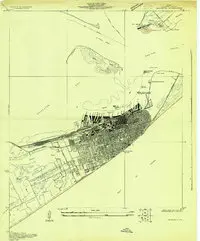
- USGS 1:24000-scale Quadrangle for Galveston, TX 1930 — U.S. Geological Survey, 1930 · Public domain (USGS)
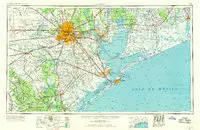
- USGS 1:250000-scale Quadrangle for Houston, TX 1956 — U.S. Geological Survey, 1956 · Public domain (USGS)
- "Broadway Cemetery" — Ghost City Tours — Ghost City Tours (commercial ghost tour, weak source
- "Cemetery Soul Stroll" — Galveston Historical Foundation — Galveston Historical Foundation
- "Ghost of Nicaragua Smith Still Haunts Graveyard" (W. T. Block Jr., 2006) — Texas Escapes — Texas Escapes
- "The grave history of Galveston's cemeteries" (Robert Arnold, 23 Oct 2015) — KPRC 2 / Click2Houston — KPRC 2 / Click2Houston
- Wikipedia article — Wikipedia · CC BY-SA 4.0
Text written by AI from the sources above and checked by a separate AI fact-check (how we work). Images: credits and licenses under each picture.
Spotted a mistake? Report an error