
Haunted place · Louisiana, United States
Cherokee Plantation
Updated November 20268 sourcesHow to visit
- Protected heritage
- 13 archive documents
Creole raised cottage on Louisiana's Cane River, site of a deadly 1839 duel; the victim's spirit and a Shirley MacLaine encounter fuel its ghost lore.
The story
Cherokee Plantation stands on the Cane River Road in the community of Natchez, southeast of Natchitoches, in the stretch of riverbank the early French settlers called the Côte Joyeuse, the "Joyous Coast." This was the heartland of Louisiana's first French and Creole planters, and the land under Cherokee has a paper trail reaching back to Spanish colonial land grants of 1795.
Through marriages in the Metoyer and Prudhomme families, the property came to Clarisse Prudhomme, who married Charles Emile Sompayrac in 1837. On December 19, 1839, Sompayrac formally bought 1,339 arpents (about 1,133 acres) for $45,015. The deed valued the improvements at more than $33,000, named the enslaved people sold with the land and mentioned a cistern. Nobody knows for certain who built the house. Estimates range from about 1825 to 1849; 1839 is the date usually quoted, but it is the purchase date, not a documented construction date. The architects who later helped restore it believed the house already stood in 1839 and that Sompayrac enlarged it for his wife.
The Sompayracs were a French family: Emile's father, Ambroise, had come to Natchitoches from the Tarn region of France in 1803 and sent his four sons back to France for schooling. Life on the plantation mixed Creole and French habits with Southern sporting culture. Newspapers from 1851 found under old wallpaper turned out to be Baltimore horse-racing and cockfighting sheets, and the Sompayrac family had an interest in the Natchitoches racetrack. The wealth behind it all came from forced labor. The plantation grew mainly cotton, along with indigo, sugarcane, corn and tobacco, and by 1860 Sompayrac held 65 people in slavery. It was the enslaved workers who gave the place the name that stuck: "Cherokee," after the thick hedges of Cherokee roses on the property.
The grounds also saw one of the most notorious duels in Louisiana history. In 1839 (the NRHP nomination places it the day after Sompayrac signed his deed; Wikipedia says autumn), a political quarrel between State Senator Pierre E. Bossier, a Democrat from an old Creole family, and General François Gaiennie of Cloutierville, a Whig and adjutant-general of the state militia, ended in a challenge. The two men met on open ground behind the house, with Emile Sompayrac and his brother serving as seconds. Gaiennie fired first and missed, perhaps deliberately, as was rumored at the time; Bossier's shot killed him on the spot. An 1890 regional history counted eleven further deaths in the feuding that followed. Bossier went on to Congress in 1842 and died in 1844, by suicide according to the nomination form, at 47.
The house came through the Civil War without damage. It was known as the Emile Sompayrac Place until 1890 and as the Murphy Place afterward: R. C. Murphy bought it in 1891, together with much of the furniture of a French Cane River family, and it stayed in his family: in January 1972 one of his granddaughters bought the house and carried out a careful restoration, and it was added to the National Register of Historic Places on August 14, 1973. It lies within the Cane River National Heritage Area.
The legend
The haunted reputation of Cherokee rests on a small number of stories, almost all of them gathered in one place: the "Cherokee Plantation" chapter of *A Haunted History of Louisiana Plantations* by Cheryl H. White and W. Ryan Smith (Arcadia/The History Press, 2017).
The oldest strand of the legend concerns the duel. According to that book, the fight left blood on the plantation grounds, and the spirit of the man who fell is said to roam them still. The book frames the duel as an illegal affair of honor; the available excerpt of the book does not name the ghost, but the only documented duel death at Cherokee is that of François Gaiennie in 1839. When this ghost story first appeared is unknown.
The best-known account is a celebrity one. While *Steel Magnolias* was being filmed in Natchitoches (the movie came out in 1989), actress Shirley MacLaine visited Cherokee and reported a paranormal encounter there. What exactly she experienced is not described in the sources available. Wikipedia, citing the same 2017 book, adds that the family living in the house had been telling similar stories of activity for many years.
That is the full extent of the documented lore. No apparition is described in detail, no paranormal television investigation was found, and no historian or skeptic appears to have examined the claims. The ghost stories should be read as family tradition and anecdote, recorded in a popular regional book, rather than as anything established.
What remains today
The 1973 nomination describes a classic early Louisiana raised cottage in the West Indies style, set well back from the road among live oaks and pecans, painted soft white with dark green shutters. The living floor sits more than six feet off the ground. Twelve-foot-wide porches run along three sides, supported by eighteen simply carved square columns of hand-hewn cypress under a hipped roof without dormers. The whole frame, from sills to ceiling beams, is enormous hand-hewn cypress, a feat of skilled work generally credited to enslaved craftsmen. Architects believe the original house had four rooms ringed by galleries, with a detached kitchen; the north side was closed in early on.
Inside, according to the same description, the restoration kept the heart-pine floors and the bousillage walls, made of river mud mixed with Spanish moss and finished with mud and deer hair. The ceiling beams are left exposed and the spaces between them are painted in bright colors, heavy on indigo blue, a crop once grown here. Six original fireplaces with cypress mantels survive, as do hand-blown window panes. Folding faux-bois doors, said to have come from France via New Orleans, can open the parlor and dining room into one space. A punkah fan over the dining table and much of the iron hardware were made in the plantation's own blacksmith shop, and a wine cellar under the old pantry was rebuilt on its original foundations. The furnishings at the time included an eleven-foot armoire built by enslaved cabinetmakers on Cane River. Three old barns, one a log crib, stand nearby, and across the road on the riverbank is a former slave cabin with its original fireplace, adapted as caretakers' quarters.
Visiting
Cherokee Plantation is, as far as we could find, a private residence and is not open for regular visits or ghost tours. Do not enter the grounds or approach the house uninvited. The house is set back from the Cane River Road, and the setting can be appreciated respectfully from the public road. Public access may occasionally be possible during local heritage events like the Natchitoches Fall Pilgrimage; that remains unconfirmed, so check with the local tourism office before planning around it.
For a legal way to explore the same landscape, look to the wider Cane River National Heritage Area, to which Cherokee belongs, for historic sites that do welcome visitors, and ask locally which ones interpret the lives of the enslaved people who built and worked these plantations. Natchitoches itself, where *Steel Magnolias* was filmed, is close by.
The ghosts
Spirit
The duel victim of Cherokee
Said to be Possibly General François Gaiennie, killed in the 1839 duel (the source excerpt does not name him)
A 2017 ghost book says the plantation grounds were bloodied by an illegal duel of honor and that the spirit of the man who died may still roam them. The only recorded duel death at Cherokee is François Gaiennie's, shot by Pierre Bossier in 1839.
- Apparitions
Reported by: Cheryl H. White and W. Ryan Smith, A Haunted History of Louisiana Plantations (2017)
Spirit
Unidentified presence in the house
Shirley MacLaine reported a paranormal encounter while visiting during the filming of Steel Magnolias, and the resident family had long told of similar activity. No details of what was seen or felt are recorded in the sources.
First reported: c. 1988. Reported by: Shirley MacLaine; the resident family (via White and Smith 2017, cited by Wikipedia)
Photographs

From the archives


Old maps
Where it is
The circle shows the general area only. Open on the full map
Sources
- National Register nomination #73000869 (texte intégral) — U.S. National Park Service · Public record
- National Register of Historic Places file (NRHP #73000869) — U.S. National Park Service · Public domain (U.S. government)
- Wikimedia Commons category : Cherokee Plantation (Natchez, Louisiana) — Wikimedia Commons
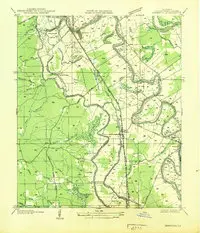
- USGS 1:31680-scale Quadrangle for Bermuda, LA 1937 — U.S. Geological Survey, 1937 · Public domain (USGS)
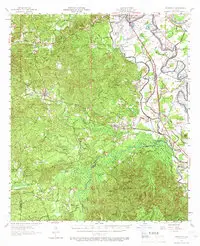
- USGS 1:62500-scale Quadrangle for Provencal, LA 1957 — U.S. Geological Survey, 1957 · Public domain (USGS)
- Cheryl H. White & W. Ryan Smith, *A Haunted History of Louisiana Plantations* (Arcadia Publishing, 2017) — Google Books page (not read directly) — Google Books page (contents and snippet
- Official website
- Wikipedia article — Wikipedia · CC BY-SA 4.0
Text written by AI from the sources above and checked by a separate AI fact-check (how we work). Images: credits and licenses under each picture.
Spotted a mistake? Report an error