
Haunted place · New York, United States
The Amityville Horror
Updated November 20266 sourcesHow to visit
- 2 archive documents
A real 1974 mass killing on Long Island, then a 1975-76 haunting claim a lawyer reportedly later called invented; the 1977 book and the films spread it.
The story
On 13 November 1974, six members of one family were killed in a house in Amityville, on Long Island’s south shore in New York. The eldest son, Ronald DeFeo Jr., was found guilty of second-degree murder in November 1975. According to Wikipedia, which is our only source for it, he died in prison in March 2021. We have not read the 1974 and 1975 New York Times reports that Wikipedia cites for these dates, so they rest on the encyclopedia. We do not name the victims and we do not give the address: the house is a private home.
In December 1975 George and Kathy Lutz bought the house and moved in with their three children. The date is disputed. According to Wikipedia, the book gives both 18 December (first chapter) and 23 December (prologue), county records show the purchase on 23 December, and two Newsday reports differ as well. They left on 14 January 1976, after about 28 days, and said they had been driven out by paranormal events.
The case moved quickly from there. On 14 February 1976 Newsday printed the first public article we know of, under the headline “DeFeo Home Abandoned; Buyer Calls It Haunted” (cited by Wikipedia; we have not read the article). According to Wikipedia, someone close to the matter gave a different reason there for the departure: a broken heating system. Two days later the Lutzes gave a press conference at the office of William Weber, the lawyer who had defended DeFeo. On 6 March 1976 Ed and Lorraine Warren visited with a television crew. The Psi Encyclopedia of the Society for Psychical Research says the Lutzes, Weber and the journalist Paul Hoffman met in January 1976 to turn the story into a book; that rests on a single source and we could not cross-check it.
In May 1977 the Lutzes sued Weber, Hoffman and others, along with Good Housekeeping, the New York Sunday News and the Hearst Corporation. The claims against the publishers were dropped, and counter-suits followed. On 13 September 1977 Jay Anson’s book The Amityville Horror was published by Prentice Hall, drawn from about 45 hours of recordings made by the Lutzes (Wikipedia). In September 1979 Judge Jack Weinstein dismissed the rest of the Lutzes’ claims. The first film came out the same year.
The legend
The account the Lutzes told publicly, and that the book and film popularized, is of a malevolent presence rather than a named ghost: flies, odors, cold, noises and marks. No identity is given for the presence. The oldest trace we found is the February 1976 Newsday piece, a month after the family left. Nothing we read describes paranormal reports about the house before the Lutzes’ stay.
A photograph said to show a ghostly boy, reportedly taken in 1976 during the Warrens’ visit, was published only in 1979, according to Wikipedia.
The claim that the haunting was invented is old and specific. Weber is reported to have told People magazine, in its issue of 17 September 1979: “I know this book is a hoax. We created this horror story over many bottles of wine.” We cannot vouch for those words. We read them in Wikipedia, which gives this wording and date but no footnote on the quote itself, and in the Psi Encyclopedia, which prints “this book’s a hoax” and draws the passage from Ric Osuna’s website, The Amityville Murders. We have not seen the magazine issue, and neither Snopes nor the Osuna page would open for us. This is the single most important point we could not verify. The Psi Encyclopedia also reports that the judge said: “It appears to me that to a large extent the book is a work of fiction.” Wikipedia cites two skeptical articles, by Bartholomew and Nickell (Skeptic, 2016) and by Kreidler (Skeptical Inquirer, 2003). Neither would open for us, so we cannot describe their arguments. Our research lists two critical books we have not read: one by Stephen and Roxanne Salch Kaplan (1995) and Osuna’s The Night the DeFeos Died (2002).
The Lutzes never admitted a hoax. George Lutz maintained that the story was mostly true. The Lutzes also pointed to a lie detector test from June 1979, which Wikipedia describes as unreliable evidence. George Lutz filed a trademark in 2002; Kathy Lutz died on 17 August 2004 and George on 8 May 2006.
The story then became a long run of films. Wikipedia explains that because the town and the events are real, no producer owns them outright. That is why most of the films after the 1979 original barely connect with each other, and why several move to other buildings in the town or to haunted objects such as a lamp, a clock or a mirror. Amityville II is a prequel drawn from a Hans Holzer book, and Amityville 3-D draws on the investigator Stephen Kaplan, who disputed the Lutz story as a hoax. A remake followed in 2005. The 2012 documentary My Amityville Horror gives the version of Daniel Lutz, a child when the events took place.
What remains today
The house still exists and is a private residence. Nothing there is open to the public. What remains of the story is mostly paper and film: the 1977 book, the 1979 film and its many successors, and the argument between believers and skeptics.
Our reading of the evidence is that the crime is real, that the haunting claim first appears in public a month after a family left a house they had lived in for four weeks, and that a lawyer involved is reported to have called the book a hoax. The sources we could actually open do not show an independent paranormal event. Some details remain disputed, including the move-in date and, between the Psi Encyclopedia and Wikipedia, the year of the book (the Psi text says 1979 where Wikipedia says 1977; one of them is probably mistaken, and we follow 1977).
Visiting
There is nothing to visit. The house is a private home, and we deliberately give no address. Please do not go looking for the house or treat the street as an attraction. If you want to follow the case, start with the sources: the 1976 Newsday articles and the 1974 and 1975 New York Times reports that Wikipedia cites (we have not read them), the Psi Encyclopedia entry on the Amityville hoax, and the critical books named above. Status as of our research in November 2026.
The ghosts
Spirit
The Amityville presence (the Lutz account)
George and Kathy Lutz said that a malevolent presence drove them out of the house after about 28 days. The report was shaped into Jay Anson’s 1977 book. A lawyer connected to the case is reported to have called the story a hoax, and the Lutzes never admitted one.
- Smells
- Cold spots
- Photographs
First reported: 14 February 1976 (Newsday, as cited by Wikipedia). Reported by: George and Kathy Lutz; the Warrens’ visit of 6 March 1976; the 1977 book and 1979 film
Photographs


Old maps
Where it is
The circle shows the general area only. Open on the full map
Sources
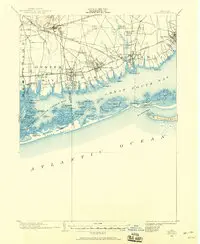
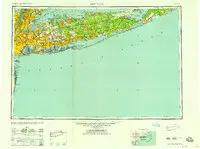
- USGS 1:250000-scale Quadrangle for New York, NY 1958 — U.S. Geological Survey, 1958 · Public domain (USGS)
- USGS 1:62500-scale Quadrangle for Babylon, NY 1901 — U.S. Geological Survey, 1901 · Public domain (USGS)
- Amityville Hoax — Psi Encyclopedia (Society for Psychical Research)
- The Amityville Horror — Wikipedia
- The Amityville Horror (franchise) — Wikipedia
- Wikipedia article — Wikipedia · CC BY-SA 4.0
Text written by AI from the sources above and checked by a separate AI fact-check (how we work). Images: credits and licenses under each picture.
Spotted a mistake? Report an error