
Haunted place · Ohio, United States
Cincinnati Music Hall
Updated November 202614 sourcesHow to visit
- As seen on Ghost Hunters
- Protected heritage
- 8 archive documents
Cincinnati's 1878 Gothic concert hall, built over a Potter's Field whose bones keep resurfacing; staff describe friendly spirits and Ghost Hunters visited.
The story
Music Hall occupies most of a city block on Elm Street in Over-the-Rhine, across from Washington Park, a short walk north of downtown Cincinnati. Finished in 1878, it is the home stage of the Cincinnati Symphony Orchestra, the Cincinnati Pops, Cincinnati Opera, Cincinnati Ballet and the May Festival Chorus, and it has also booked pop and rock concerts over the years.
The hall grew out of a city that took music seriously. Cincinnati, ranked seventh among American cities by population in 1870 and fond of calling itself the "Athens of the West," had a strong German-American tradition of choral festivals, or Saengerfests, which the National Register nomination cites as the hall's cultural root. Large events were held in the Exposition Hall, a wooden giant some 250 feet long under a tin roof, which also hosted the 1876 Republican National Convention that chose Rutherford B. Hayes. A favorite local story holds that during an 1875 May Festival concert a thunderstorm pounded that roof so loudly the chorus could no longer be heard and the performance had to stop. One listener was the rich German-American businessman Reuben R. Springer (1800-1884), who came away convinced that the city deserved a permanent hall.
The commission went to local architect Samuel Hannaford. His building, described as High Victorian Gothic in the nomination and as Venetian Gothic by the landmark citation, is really three structures behind one long front: the central auditorium flanked by the North and South Exposition Buildings, designed for industrial fairs. Upper-floor passages joined them from the start, so a single event could fill all three, and covered carriage drives let concertgoers step down out of the weather. The nomination considers it probably the last surviving early American civic center, pairing art and industry under one roof. Red brick trimmed with black brick and white stone rises to a steep central gable framing a large rose window. Theodore Thomas led the May Festivals from the 1878 opening until 1904, and the auditorium earned a national name for its acoustics.
The building was placed on the National Register in 1970 and designated a National Historic Landmark in January 1975. Even so, the National Trust for Historic Preservation named it one of America's 11 most endangered historic places in June 2014. It then closed for more than a year for a $143 million renovation and reopened in 2017.
What lies beneath the hall matters as much as what stands above it. The southern part of the site was once the city's Potter's Field, a burial ground for the poor and the unclaimed that appears on an 1830 map and, according to Wikipedia, was used heavily after the 1832 cholera outbreak and into the 1850s. The northern part held the Cincinnati Orphan Asylum from 1842. The dead have resurfaced repeatedly. In October 1876, digging for the foundations turned up the first skeletons, and boxes of remains were taken for reburial at Spring Grove Cemetery. In February 1927 workers found three coffins, one with a headstone for a George Pollock who died in 1831; souvenir hunters made off with bones and a skull, and later that year some 65 graves were uncovered under the south wing, which earned the nickname "Valley of Death." In May 1988, a crew boring a fresh elevator shaft hauled out over 200 pounds of human bone. The coroner checked them for signs of a crime, and forensic anthropologist Elizabeth Murray, a Mount St. Joseph professor, studied them for her doctoral dissertation. The 2016-2017 renovation exposed still more burials, beneath the orchestra pit and along the north carriage drive, which archaeologists lifted out. A popular claim that victims of the 1838 steamboat *Moselle* explosion lie here is doubtful: most 1876 *Enquirer* reports placed them in a different Potter's Field, at today's Lincoln Park.
The legend
The ghost stories are almost as old as the building. In 1876, while the foundations were being dug, a newspaper piece titled "Gossip About City Ghosts," credited to a writer named Hearn (very likely Lafcadio Hearn, then a Cincinnati reporter, though this is not confirmed), was already connecting ghosts to the excavation. Wikipedia adds that the first reports came when ground was opened for an elevator in the earlier Exposition Hall. Ever since, the hall's spirits have usually been tied to the paupers and unclaimed dead buried below, and most witnesses call them friendly.
Some of the testimony comes from well-known figures. In the 2005 CET documentary *Music Hall: Cincinnati Finds Its Voice*, Cincinnati Opera chief Patricia K. Beggs said that yes, "there are Music Hall ghosts." Erich Kunzel, the late conductor of the Cincinnati Pops, said that on nights when he stayed late arranging music he had met "these people," not in the offices but out in the auditorium and upstairs, and he challenged doubters to come at three in the morning; he found them "very friendly."
The Friends of Music Hall, the volunteer group that preserves the building's history, has collected more specific accounts. A night watchman, John Engst, wrote that he heard music with no source, especially near the first-floor elevator shaft, and felt a tingling near that spot for about two weeks. The young son of an opera employee, about three years old, waved at a man in Box 9, then the box of music director Jesús López-Cobos, while the hall was dark; his father saw nobody there. A box-office worker who answered a bell with no one at the window reported that a small boy in old-fashioned knickers and a cap tugged at his sleeve. A girl in a dirty dress of the kind worn at the orphanage has been described more than once, a figure many link to the asylum that stood on the north end. Other reports gathered by Syfy include a woman dancing in the ballroom, lights switching on and off, footsteps, seats moving and an elevator traveling by itself.
Television followed. *Ghost Hunters* closed its ninth season with "Phantoms of the Opera" (S09E26), broadcast October 29, 2014, in which the TAPS investigators said they caught a child calling "Mommy" down in the basement and, at 3 a.m., saw a figure waving from the balcony. The Travel Channel also listed the hall among its *Most Terrifying Places in America*, and former Music Hall director Scott Santangelo wrote up the stories in a blog series.
Not everyone is convinced. Marie Gallagher, who worked at the hall for 25 years, and facilities engineer Ed Vignale both said they had never experienced anything out of the ordinary. Vignale pointed out that a room built to carry sound perfectly will also carry stray noises in surprising ways, which is a sensible caution for anyone listening for phantom music in an empty auditorium.
What remains today
The polychrome Gothic exterior survives with its steep gables, corbeled brickwork, traceried windows and great rose window. At the time of the National Register nomination the central auditorium had kept its historic character, while the old exhibition wings had long since been carved into dressing rooms, offices, rehearsal rooms, scenery storage and workshops for the resident companies. Our sources do not detail what the 2016-2017 renovation changed inside.
Visiting
Music Hall is a working performing arts venue, so the simplest way inside is a ticket to a symphony, Pops, opera or ballet performance.
For the ghost side of the building, the volunteer Friends of Music Hall have offered Ghost Tours of Music Hall, booked through Cincinnati Arts and the box office, which take visitors through the darkened foyer, the basement and Corbett Tower. The group also runs history tours such as "Backstage and Beyond" and "Bricks & Beer." Cincinnati Arts lists Ghost Tours among its Music Hall tours; check the current schedule before planning a visit. Outside of tours and performances, backstage and service areas are off limits; please do not go looking for spirits on your own.
The ghosts
The dancing woman
A woman is said to have been seen dancing in the ballroom. This comes from a single source.
- Apparitions
Reported by: Syfy (Ghost Hunters recap)
Spirit
The friendly presences of the house
Said to be Often linked in lore to the pauper's cemetery beneath the building
Conductor Erich Kunzel said that while working through the night he met 'these people' in the auditorium and upstairs, and found them very friendly. Opera CEO Patricia K. Beggs also acknowledged Music Hall ghosts; other long-time staff say they never noticed anything.
- Apparitions
First reported: Before 1878, during excavation for the Exposition Hall elevator. Reported by: Erich Kunzel; Patricia K. Beggs (2005 documentary Music Hall: Cincinnati Finds Its Voice); Ghost Hunters S09E26
Spirit
The friendly spirits of the Potter's Field
Said to be Linked in lore to the poor and unclaimed dead buried under the building
Since the foundations were dug in 1876, ghosts have been tied to the paupers' cemetery under the hall. Conductor Erich Kunzel said he met friendly 'people' in the auditorium and upstairs on late nights, and Opera CEO Patricia K. Beggs said there are Music Hall ghosts; a night watchman heard sourceless music near the elevator shaft.
- Apparitions
- Phantom music
First reported: 1876. Reported by: 'Gossip About City Ghosts' (1876, Hearn); Erich Kunzel; Patricia K. Beggs (CET documentary, 2005); John Engst; Friends of Music Hall
The little boy in knickers
After a bell rang at an empty box-office window, a staff member felt his sleeve tugged by a small boy dressed in knickers and a cap.
- Apparitions
- Being touched
- Bells
Reported by: Friends of Music Hall; Syfy
Spirit
The man in Box 9
An opera employee's small son, then three, waved at a man in Box 9 while the hall was dark; his father saw no one there.
- Apparitions
Reported by: Friends of Music Hall; Syfy
The orphanage girl
Said to be Associated with the Cincinnati Orphan Asylum that occupied the north part of the site from 1842
A girl in a dirty orphanage-style dress has reportedly been seen several times in the building.
- Apparitions
Reported by: Friends of Music Hall; Syfy
Photographs


From the archives


Old maps
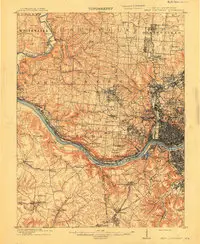
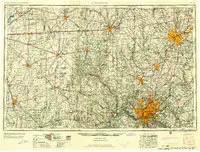
Investigated on TV
- Ghost Hunters · Season 9, episode 26 — “Phantoms of the Opera”2014
Where it is
The circle shows the general area only. Open on the full map
Sources
- National Register nomination #70000496 (texte intégral) — U.S. National Park Service · Public record
- National Register of Historic Places file (NRHP #70000496) — U.S. National Park Service · Public domain (U.S. government)
- Sermons and sayings : Cincinnati music hall series — Internet Archive · Jones, Sam P. (Sam Porter), 1847-1906, 1886-01-01 · Public domain (pre-1929)
- The Cincinnati Organ: With a Brief Description of the Cincinnati Music Hall — Internet Archive · George Ward Nichols, 1878-01-01 · Public domain (pre-1929)
- Wikimedia Commons category : Cincinnati Music Hall — Wikimedia Commons
- USGS 1:250000-scale Quadrangle for Cincinnati, OH 1957 — U.S. Geological Survey, 1957 · Public domain (USGS)
- USGS 1:62500-scale Quadrangle for West Cincinnati, OH 1914 — U.S. Geological Survey, 1914 · Public domain (USGS)
- "Bones Discovered Under Music Hall" — Friends of Music Hall — Friends of Music Hall
- "Episode Recap: Phantoms of the Opera" — Syfy — Syfy
- "Is Music Hall Haunted?" — Friends of Music Hall — Friends of Music Hall
- "List of Ghost Hunters episodes" — Wikipedia — Wikipedia
- "Music Hall Tours" — Cincinnati Arts — Cincinnati Arts
- Official website
- Wikipedia article — Wikipedia · CC BY-SA 4.0
Text written by AI from the sources above and checked by a separate AI fact-check (how we work). Images: credits and licenses under each picture.
Spotted a mistake? Report an error