
Haunted place · Ohio, United States
Camp Chase
Updated November 202610 sourcesHow to visit
- Protected heritage
- 7 archive documents
The last trace of Camp Chase, a Civil War prison in Columbus, Ohio: a cemetery of some 2,200 Confederates, haunted, legend says, by a Lady in Gray.
The story
Camp Chase opened in May 1861, weeks after the Civil War began, on land leased by the federal government about four miles west of downtown Columbus, Ohio, along the National Road. It took over from Camp Jackson, a far smaller post that Governor William Dennison Jr. had set up in a city park for Ohio's first volunteers, and was formally dedicated on June 20, 1861. It took its name from Salmon P. Chase, a former Ohio governor who was then Lincoln's Treasury Secretary and later became Chief Justice. The site lies in what is now the Hilltop neighborhood.
The camp wore many hats: training ground for Ohio volunteers, muster and parole station and, increasingly, a prison. As many as 150,000 Union soldiers passed through. In its early months its captives were mostly civilians: officeholders such as judges, mayors and lawmakers from western Virginia and Kentucky accused of siding with the Confederacy, among them former congressman Richard Henry Stanton. Confederate officers were held briefly in early 1862, until the officers' prison at Johnson's Island opened; after that Camp Chase kept enlisted men, non-commissioned officers and civilians. Men captured in Morgan's Raid in 1863, including Colonel Basil W. Duke, also ended up here.
The stockade grew in stages. Prison No. 1 began with three frame barracks behind a twelve-foot plank wall with guard towers, holding 450 men. Prison No. 2 followed in November 1861 and Prison No. 3, a three-acre cluster of small plank huts, in March 1862. When a prisoner-exchange agreement collapsed in July 1863, the population soared. In summer 1864 the huts were torn down and replaced with seventeen larger barracks, built by prisoner labor from salvaged lumber, raising capacity to about 8,000; the camp soon exceeded even that, holding more than 9,400 men by February 1865. Wikipedia estimates that some 25,000 Confederates passed through; the 1972 National Register nomination gives 26,000 of the 36,000 held in all of Ohio's military prisons.
Conditions were grim. Rations were cut in retaliation for reported abuse in Southern camps, and malnutrition, smallpox, typhoid and pneumonia took a steady toll, made worse by the harsh winter of 1864-65. The nomination counts 2,260 deaths by the official closing date of July 5, 1865. Its buildings were dismantled, and by September 1867 salvaged materials, supplies and 450 patients from Columbus's Tripler Military Hospital had been shipped to Dayton to help equip the newly founded National Asylum for Disabled Volunteer Soldiers.
Only the cemetery, begun in 1863, survived. In 1895 a former Union soldier, William H. Knauss, organized its first memorial service, and he published a history of the camp in 1906. The memorial arch was dedicated in 1902, Congress authorized marble headstones in 1906, and the stone wall and speaker's platform were built in 1921. The United Daughters of the Confederacy held a yearly service there between 1912 and 1994; the Hilltop Historical Society now organizes the event on the second Sunday of June.
The legend
The cemetery's ghost is the Lady in Gray, sometimes called the Grey Lady or the Veiled Lady. Most versions make her a woman in her late teens or early twenties, clad all in gray, with a spotless white handkerchief in her hand. She walks among the rows reading the names on the headstones, searching, the story says, for a lost love she can never find. Related accounts describe fresh flowers appearing on graves with nobody seen leaving them, and the sound of a woman weeping. The grave most often linked to her is that of Private Benjamin F. Allen of Company D, 50th Tennessee Infantry, captured at Missionary Ridge in November 1863, brought wounded to Camp Chase in March 1864 and dead of pneumonia that September; he lies in grave 233.
When the story began is disputed. Wikipedia places the sightings in the years just after the Civil War, saying she was seen often for several years and then vanished. Mental Floss, in a roundup of spooky cemetery tales, instead dates the ghostly version to after 1950, when the flowers and crying began to be credited to a dead woman's spirit.
That woman was real. Louisiana Ransburgh Briggs (1849-1950), from a family of New Madrid, Missouri, was sent north to Ohio during the war and in 1867 married Joseph M. Briggs, a Union veteran. For years she quietly laid flowers on Confederate graves while wearing a veil, and she later helped reclaim and care for the neglected cemetery. The heritage volunteers who research the cemetery, members of the Sons of Confederate Veterans and the United Daughters of the Confederacy, are blunt: the "veiled lady" was a living woman, not a ghost. They also doubt the romance with Allen, noting that she would have been about thirteen in 1864, that he was roughly thirty-one (Mental Floss says 22), and that they lived about 116 miles apart. They suggest a reporter may have invented the love story to draw attention to the cemetery. Claims that she was a Confederate soldier's widow are not supported.
A more recent claim came from local paranormal investigators who told Columbus station 10TV (WBNS) they had photographed a shadowy soldier while standing at Allen's grave. No television ghost-hunting series has featured the site.
What remains today
None of the camp's buildings survive; the rest of the grounds became homes and businesses. The cemetery occupies less than two acres inside a stone wall from 1921. Inside the entrance stands the 1902 granite memorial arch, carved with the word AMERICANS on its keystone and topped by a bronze Confederate soldier facing south, which vandals beheaded in 2017; it was repaired and reinstalled in 2019. Rows of marble government headstones mark the graves. Figures vary between sources: the 1972 nomination counts 2,199 graves inside the wall, while Wikipedia gives 2,260, including men who died at Camp Dennison near Cincinnati. The site has been on the National Register since the 1970s and was federally owned when it was nominated.
Visiting
The Camp Chase Confederate Cemetery is a public cemetery in the Hilltop neighborhood of Columbus and is open to visitors. It is a war grave site, so behave respectfully, stay off the graves and do not leave anything that could damage the stones. There is no organized ghost tour. The best time to learn its history is the annual memorial service held by the Hilltop Historical Society on the second Sunday of June. Nothing remains of the prison itself, so the surrounding streets are ordinary residential and commercial blocks.
The ghosts
Shadow soldier at Allen's grave
Local paranormal investigators told 10TV they had photographed a shadowy soldier figure while standing at Benjamin Allen's grave. The claim rests on that single report.
- Photographs
Reported by: Local paranormal investigators via 10TV / WBNS
The Lady in Gray
Said to be Often linked to Louisiana Ransburgh Briggs (1849-1950), who secretly laid flowers on the graves while veiled; heritage researchers say she was a living woman, not a ghost
A young woman in gray with a white handkerchief walks among the headstones reading names, looking for a lost love, often said to be Pvt. Benjamin F. Allen (grave 233). Fresh flowers and a woman's crying are attributed to her. Cemetery historians argue the legend grew from Louisiana Briggs's real visits and that the Allen romance was likely invented.
- Apparitions
- Crying
First reported: Disputed: just after the Civil War (Wikipedia) or after 1950 (Mental Floss). Reported by: Wikipedia; Mental Floss; campchase.us (SCV/UDC researchers)
Photographs


From the archives


Old maps

Where it is
The circle shows the general area only. Open on the full map
Sources
- National Register nomination #73001434 (texte intégral) — U.S. National Park Service · Public record
- National Register of Historic Places file (NRHP #73001434) — U.S. National Park Service · Public domain (U.S. government)
- The story of Camp Chase; a history of the prison and its cemetery, together with other cemeteries where Confederate prisoners are buried, etc — Internet Archive · Knauss, William H, 1906-01-01 · Public domain (pre-1929)
- Wikimedia Commons category : Camp Chase — Wikimedia Commons
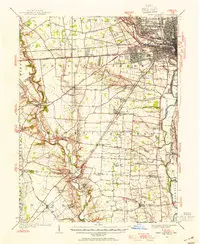
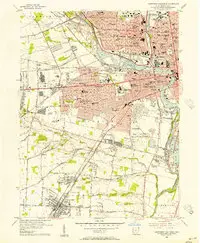
- USGS 1:24000-scale Quadrangle for Southwest Columbus, OH 1955 — U.S. Geological Survey, 1955 · Public domain (USGS)
- USGS 1:62500-scale Quadrangle for West Columbus, OH 1923 — U.S. Geological Survey, 1923 · Public domain (USGS)
- Local paranormal investigators claim capture of ghostly image of soldier at Camp Chase Cemetery — 10TV / WBNS (not read directly) — 10TV / WBNS (read via search excerpt only
- Six Seriously Spooky Cemetery Stories — Mental Floss — Mental Floss
- The Lady Behind the Veil: The Life of Louisiana Ransburgh Briggs — campchase.us (Dennis Ranney, SCV, & Joanie Jackson, UDC) — campchase.us (Dennis Ranney, SCV, & Joanie Jackson, UDC
- Wikipedia article — Wikipedia · CC BY-SA 4.0
Text written by AI from the sources above and checked by a separate AI fact-check (how we work). Images: credits and licenses under each picture.
Spotted a mistake? Report an error