
Haunted place · California, United States
Whittier Mansion
Updated November 20266 sourcesHow to visit
- Protected heritage
- 19 archive documents
A sandstone 1896 mansion in San Francisco's Pacific Heights that briefly served Nazi Germany in 1941; its haunted reputation rests on one 1989 book.
The story
On Christmas Eve 1894 the San Francisco Chronicle previewed an ambitious new house. The architect Edward R. Swain had just finished plans for William Franklin Whittier, a financier born in Vienna, Maine, who wanted a residence in Pacific Heights, on a lot with views over the bay to the Golden Gate. The paper put the cost at about $90,000 and called it the first house in the city to be built entirely of stone, a claim the later National Register nomination corrects: only the outer shell was stone, with steel beams inside, and the Flood brownstone on California Street was older. Construction took longer than promised, and the family moved into the thirty-room house in August 1896.
The Chronicle account, annotated in the 1976 nomination to show what was actually built, gives a vivid picture of a Gilded Age household. Visitors passed through a marble vestibule with a mosaic floor into oak-paneled halls, an octagonal reception room finished in gilded "vernis Martin" veneer, a long mahogany living room, a round smoking room with views of the bay, and a dining room with a domed plaster ceiling. A passenger elevator ran from basement to attic, the basement held a large paneled room for suppers and dances alongside the servants' quarters, and Whittier's son, W. R., had the whole width of the top floor to himself, close to a "sporting room" for guns and fishing rods and a billiard room with a view north.
The house came through the 1906 earthquake, one of relatively few buildings to do so. Whittier died in 1917, and his daughter let it to tenants. One of them was Fritz Wiedemann, whose tenancy preceded the house's sale to Germany; Wikipedia says he may have rented from 1939, while the nomination has him moving in on April 30, 1941. On April 29, 1941, the German Reich bought the house through intermediaries for $44,000 in cash. For a few months it served as the consulate, a center for espionage and a coordination point for the German-American Bund, until the United States expelled German diplomats on July 15, 1941 (the nomination says the consulate closed on June 30, 1941). After the war the Office of Alien Property Custodian seized the house in 1947, and it was auctioned in 1950.
From 1956 to 1991 the mansion was the home of the California Historical Society, which opened it as a semi-public building and museum. It became San Francisco Designated Landmark No. 75 in 1975 and entered the National Register of Historic Places in 1976. After the society moved out in 1991 it returned to private use.
The legend
Wikipedia describes the Whittier Mansion as purported to be haunted, but the claim rests on a single source: Dolores Riccio's book Haunted Houses U.S.A., published in 1989. No reachable source names a ghost, describes a specific phenomenon, or records an investigation, and no television coverage was found.
That gap matters, because popular retellings online sometimes connect a ghost to the house's months as a Nazi consulate or to Whittier himself. No available source supports those stories, and they should be treated as embroidery rather than tradition. When Riccio's book appeared, the mansion was open to visitors as the California Historical Society's headquarters, which may help explain how a ghost story came to be attached to it, though that is an inference, not a documented fact.
In short, this is a house with an extraordinary history and a very thin ghost story. Anyone with a primary account of strange experiences there, particularly from the Historical Society years, would be adding something genuinely new to the record.
What remains today
The mansion survives with few radical alterations, according to the nomination. Its facade is strictly symmetrical, with round corner towers, a lower story of Sespe stone, red Arizona sandstone above, and an Ionic portico. The nomination's architectural historian saw in the odd temple front squeezed onto the center of the second story an echo of the rock-cut buildings of Petra, and noted that the soft sandstone was already losing its sharp edges, with preservative coatings slightly altering the color. In 1976 a small stone pavilion with Ionic columns behind the house served as caretaker's quarters, and some of the original interior woodwork had been painted over.
Visiting
The Whittier Mansion is a private residence and is not open to the public; there are no tours. You can see the facade from the public sidewalk in Pacific Heights, but please do not linger at the door, photograph the occupants or attempt to enter the grounds. For the history of the house, the National Register nomination and the Historic American Buildings Survey record are the best sources, and the California Historical Society, its former occupant, can be a starting point for research on the building and its owners.
Photographs


From the archives


Old maps
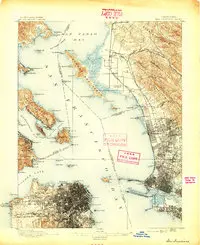
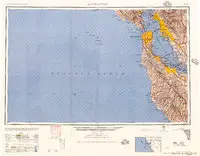
Where it is
The circle shows the general area only. Open on the full map
Sources
- National Register nomination #76000524 (texte intégral) — U.S. National Park Service · Public record
- National Register of Historic Places file (NRHP #76000524) — U.S. National Park Service · Public domain (U.S. government)
- Wikimedia Commons category : Whittier Mansion — Wikimedia Commons
- USGS 1:250000-scale Quadrangle for San Francisco, CA 1957 — U.S. Geological Survey, 1957 · Public domain (USGS)
- USGS 1:62500-scale Quadrangle for San Francisco, CA 1895 — U.S. Geological Survey, 1895 · Public domain (USGS)
- Wikipedia article — Wikipedia · CC BY-SA 4.0
Text written by AI from the sources above and checked by a separate AI fact-check (how we work). Images: credits and licenses under each picture.
Spotted a mistake? Report an error