
Haunted place · California, United States
Alcatraz Federal Penitentiary
Updated November 202614 sourcesHow to visit
- 3 archive documents
The San Francisco Bay island prison (1934-1963), whose ghost lore of cell 14-D and Capone's banjo comes from books and TV. The Park Service doesn't endorse it.
The story
Alcatraz Island lies about a mile and a quarter off the San Francisco waterfront. Its name comes from an old Spanish word for a seabird, usually translated as "the gannet". A fort occupied the island from the 1850s, and between 1910 and 1912 the U.S. Army built the main cellhouse as a military prison.
On October 12, 1933, the Department of Justice took over the Army's disciplinary barracks on the island. After modernization, with better plumbing and electricity, old tunnels filled with concrete so no one could hide or escape through them, and improved housing for staff families, it opened as a Federal Bureau of Prisons penitentiary in August 1934. Warden James A. Johnston, Attorney General Homer Cummings and Sanford Bates, the Bureau's first director, set out to build a prison with a fearsome reputation, and it was soon nicknamed "Uncle Sam's Devil's Island". Ringed by cold water and strong currents, it was billed as escape-proof.
Alcatraz was a last-resort prison for men who kept causing trouble elsewhere. The first 137 inmates arrived on August 11, 1934, from Leavenworth, Kansas, after a rail journey in sealed, guarded coaches to Santa Venetia, escorted by around 60 FBI agents, marshals and railroad police. Bank robbers, counterfeiters and killers made up most of the group.
The three-story cellhouse held four blocks, A to D, with cells of roughly 9 by 5 feet containing a bed, desk, washbasin and toilet. New arrivals usually began on the second tier of B-Block under a three-month quarantine without visits; after that, one visitor a month was allowed and mail was read for hidden messages. D-Block took the hardest cases, and six cells at its far end, known as "the Hole", were used for often brutal punishment.
Over 29 years, according to the record cited by KPIX, there were eight murders on the island and no executions. The Park Service counts 14 escape attempts involving 36 men between 1937 and 1962: most were caught, several were shot or drowned, and five were never found. Officer Royal Cline was killed during a 1938 attempt, and the 1946 "Battle of Alcatraz" ended with three of the would-be escapees, Bernard Coy, Joseph Cretzer and Marvin Hubbard, dead in a C-Block utility corridor. In June 1962 Frank Morris and two others vanished after slipping into a utility corridor behind B-Block. The penitentiary closed in 1963, and from 1969 to 1971 Native American activists occupied the island.
The legend
Few places are better known for ghost stories, but it is important to see where those stories come from. Almost all of them are carried by paranormal books, television shows and ghost-tour websites. The National Park Service, which runs the island, does not endorse them, and the ferry concessionaire's FAQ once stated plainly that there are no authenticated ghost sightings by people who lived on the island.
Wikipedia mentions a much older layer: the Ohlone were the island's earliest known inhabitants, and according to Miwok mythology the island was a dwelling place of evil spirits. No tribal or ethnographic source confirming this was found, so it is best treated with caution.
The modern legend is said to have taken shape in Haunted Houses (1979), a paperback by Richard Winer and Nancy Osborn, whose authors reportedly describe odd sensations in cell 14-D, one of the solitary cells of the Hole. That cell is the center of the lore. Visitors say it feels far colder than its neighbors (a difference of about 20 degrees Fahrenheit is often repeated) and describe a sense of being watched. A widely told story, attributed to an unnamed former guard, says that in the 1940s a prisoner locked there screamed all night about a creature with glowing eyes and was found strangled in the morning; afterwards an extra, ghostly prisoner supposedly showed up at roll call. Guards' tales of "the Thing" with glowing eyes belong to the same cluster. These accounts come from a ghost directory, not from prison records.
Al Capone, an inmate from 1934 to 1939, is said to be heard playing the banjo, most often in the showers or close to the B-Block cell he once occupied. This one has a real root: a Park Service museum caption confirms that during the 1930s Capone was the banjo player in a prisoners' band, which contradicts sites claiming he was never allowed an instrument.
Other stories include voices in D-Block cells 11 to 13 (ghost hunter Richard Senate said he felt something cold touch the back of his neck inside 12-D); clanging and voices in the C-Block corridor where the 1946 escapees died; a smell of smoke in the empty laundry; and screams in the hospital ward and mess hall. A man in a gray suit with a cap and mutton-chop sideburns is said to have appeared at the Warden's House in the 1940s, once during a Christmas party, and Warden Johnston himself is said to have heard a woman weeping inside the old dungeon walls during a tour. Psychic Sylvia Browne, visiting with a CBS crew and former inmate Leon "Whitey" Thompson, claimed to sense a hitman called Abie "Butcher" Maldowitz in the laundry; neither the man nor his killing could be confirmed in an official source. Some TV listings also mention the Birdman of Alcatraz, Robert Stroud. Most of these come from a single ghost directory.
Television has kept the legend alive. A 1992 segment of Sightings reportedly featured park staff describing footsteps, rattling chains, slamming cell doors and screams. On March 3, 2010, Ghost Hunters (Syfy) marked its 100th investigation with a live episode, "Alcatraz Live" (season 6, episode 1), presented by Josh Gates before an audience at Rockefeller Plaza. Michael Kouri, co-author of a book called Haunted Alcatraz, has described a vision in cell 14-D.
In 2014 two British tourists published a phone photo from the visiting area that they said showed a dark female figure in old-fashioned clothes. KPIX and SFist covered it skeptically, and George DeVincenzi, a guard in the 1960s, told KPIX it looked like shadows to him and that he does not believe in ghosts.
What remains today
The cellhouse, with its blocks, the D-Block solitary cells, the dining hall and the utility corridors linked to the escapes, survives as a museum within the Golden Gate National Recreation Area and is listed on the National Register of Historic Places. It draws around 1.5 million visitors a year (2010 figure). Salt air has damaged many buildings, which the Park Service is restoring and maintaining.
Visiting
Alcatraz is open to the public, but the only way to get there is by the official Park Service concessionaire's ferry, Alcatraz City Cruises; book well ahead. The day visit includes the cellhouse audio tour, built on the memories of former inmates, guards and rangers. Evening visits with ranger talks and a behind-the-scenes option are also sold, but nothing official is promoted as a ghost tour; haunted-themed walks are run only by private companies on the mainland.
Bring layers for the wind and cold of the bay, stay on open routes, and respect closed areas, which protect fragile, salt-damaged buildings.
The ghosts
Abie "Butcher" Maldowitz
Said to be A hitman said to have been killed by another inmate in the laundry; historical existence unconfirmed
Psychic Sylvia Browne claimed to sense this man in the laundry room. The name and killing appear only on ghost sites, and a smell of smoke is reported in the empty laundry.
- Smells
First reported: Often dated to 1984 (Sylvia Browne visit). Reported by: Sylvia Browne with a CBS crew and ex-inmate Leon 'Whitey' Thompson
Al Capone's banjo
Said to be Al Capone, inmate 1934-1939
Banjo music is said to be heard in the shower room or near Capone's former B-Block cell. Capone really did play banjo in the inmate band, according to a Park Service exhibit.
- Phantom music
Reported by: Ghost-tour and paranormal sites
Spirit
Evil spirits of the island
Wikipedia reports that in Miwok mythology evil spirits lived on the island. No tribal or ethnographic source confirming it was found.
Reported by: Wikipedia
The 1946 escapees
Said to be Bernard Coy, Joseph Cretzer and Marvin Hubbard, killed during the Battle of Alcatraz
The C-Block utility corridor where the three men died is said to echo with clanging and voices. Only one source reports the haunting.
- Voices
Reported by: Legends of America
Spirit
The man in the gray suit
A man in a gray suit and cap with mutton-chop sideburns is said to have appeared at the Warden's House, once during a Christmas party.
- Apparitions
First reported: 1940s (per later retellings). Reported by: Legends of America
The presence of cell 14-D
Said to be Said to be linked to an unnamed inmate who died in the Hole in the 1940s
Cell 14-D is said to be far colder than nearby cells and to give visitors a feeling of presence. A former guard's tale has a prisoner screaming about a glowing-eyed creature and being found strangled, after which a phantom extra prisoner appeared at roll call. The story comes from later retellings, not prison records.
- Cold spots
- Screams
- Apparitions
First reported: In print by 1979 (Winer and Osborn, Haunted Houses). Reported by: Richard Winer and Nancy Osborn (1979); Michael Kouri; Legends of America
Spirit
The Thing
Guards' lore in D-Block tells of an entity with glowing eyes. Only one ghost directory records it.
- Apparitions
Reported by: Legends of America
The weeping woman
Warden James A. Johnston is said to have heard a woman sobbing inside the old dungeon walls while showing visitors around. Single source.
- Crying
Reported by: Legends of America
Woman in the visitation area photo
British tourists said their phone photo of the visiting area showed a dark female figure in period dress. A 1960s guard interviewed by KPIX thought it was shadows.
- Photographs
First reported: April 2014. Reported by: Sheila Sillery-Walsh and Paul Rice; KPIX; SFist
Photographs


From the archives

Old maps
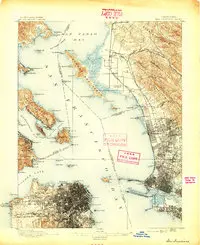
Where it is
The circle shows the general area only. Open on the full map
Sources
- Wikimedia Commons category : Alcatraz Federal Penitentiary — Wikimedia Commons
- USGS 1:250000-scale Quadrangle for San Francisco, CA 1957 — U.S. Geological Survey, 1957 · Public domain (USGS)
- USGS 1:62500-scale Quadrangle for San Francisco, CA 1895 — U.S. Geological Survey, 1895 · Public domain (USGS)
- Alcatraz City Cruises, tickets and tours page (official concessionaire)
- Book record: Richard Winer & Nancy Osborn, "Haunted Houses", Bantam, 1979, ISBN 0553128833, Biblio
- "British tourists claim their iPhone..." by Eve Batey, SFist, June 18, 2014
- "Escapes", NPS museum exhibit, Alcatraz (not read directly)
- Ghost Hunters S06E01 "Alcatraz Live", TheTVDB
- "Ghosts of Alcatraz Island, California", Legends of America (ghost/folklore directory)
- "Ghosts of Alcatraz Island, California" (page 2), Legends of America — prison
- NPS museum exhibit caption, inmate band (Capone on banjo), Golden Gate National Recreation Area (not read directly)
- Official website
- "Tourists Claim Proof Of Ghostly Figure On Alcatraz", CBS San Francisco / KPIX 5, June 19, 2014
- Wikipedia article — Wikipedia · CC BY-SA 4.0
Text written by AI from the sources above and checked by a separate AI fact-check (how we work). Images: credits and licenses under each picture.
Spotted a mistake? Report an error