
Haunted place · Pennsylvania, United States
Powel House
Updated November 20267 sourcesHow to visit
- 22 archive documents
A 1765 Georgian townhouse in Philadelphia's Society Hill, home of the Patriot Mayor, now a museum, rumored in recent books to host Peggy Shippen's ghost.
The story
The Powel House is a brick row house in Society Hill, the colonial heart of Philadelphia, completed in 1765 in the Georgian style. Its design is credited to the architect and builder Robert Smith. Like many Philadelphia townhouses of its day, it presents a restrained face to the street and saves its display for the rooms inside, and it has been praised as the city's finest Georgian row house.
The man who commissioned it never moved in. Charles Stedman, a merchant and ship captain, ran into money trouble and ended up in debtors' prison. On August 2, 1769, the house was sold for 3,150 pounds to Samuel Powel (1738-1793), a Quaker-born Philadelphian who had joined the Anglican church. Powel served as the last mayor of the city under the Crown and then as its first mayor after independence, and his support for the Revolution earned him the nickname of the Patriot Mayor.
Samuel and his wife, Elizabeth Willing Powel, redecorated on a grand scale and gave the house some of the richest interiors in colonial America. Historians credit the Rococo plaster ceilings to James Clow and the carved woodwork to Hercules Courtnay and Martin Jugiez. The couple were celebrated hosts. After the victory at Yorktown in October 1781, George and Martha Washington spent several months in the confiscated house of Governor John Penn, which shared a wall with the Powels', and the two households socialized. Other visitors included the Marquis de Lafayette, Benjamin Franklin, Benjamin Rush and John Adams, and a set of china given by Lafayette is shown in the house today.
During the 1790s, when Philadelphia was the national capital, the Powels added a three-story half-turret at the rear, perhaps inspired by the bow window Washington had built onto the President's House on Market Street. It appears in an engraving by William Birch from 1799 and in an 1817 print attributed to William Strickland, but it was torn down in the mid-19th century.
Samuel Powel died in the yellow fever epidemic of 1793, which carried off roughly a tenth of the city's population. Elizabeth stayed on and in early 1797, after John Adams declined them, bought several of Washington's belongings as he prepared to leave office, including his presidential coach and horses, his desk and a pair of girandole mirrors. In November 1798 she sold the house to William Bingham, who was married to her niece, Ann Willing Bingham.
The nineteenth and early twentieth centuries were less kind. Early in the 20th century the house served as a warehouse for horsehair and bristles, and around 1930-1931 it was slated to be torn down for a parking lot. Frances Anne Wister rescued it, founding the Philadelphia Society for the Preservation of Landmarks for that purpose.
The legend
The ghost linked to the Powel House is Peggy Shippen, born in Philadelphia in 1760 and remembered as the wife of Benedict Arnold, the general who betrayed the American cause. Wikipedia describes her as a second cousin of Elizabeth Powel. The claim that she haunts the house is, by Wikipedia's own wording, a recent one, and its only cited source is Darcy Oordt's book Haunted Philadelphia: Famous Phantoms, Sinister Sites, and Lingering Legends (2015). Oordt's book was not read for this page, and we found no other account of what it describes, whether sightings, sounds or something else.
It is worth being candid about how thin this is. Nothing in the record explains why Peggy Shippen would choose this house. She married Arnold in 1779 at her own family's townhouse on Fourth Street, not here, and she was banished from Philadelphia in November 1780 after his treason came to light. She died in London in 1804 and is buried in Battersea. The museum's operator does not mention ghosts on its page about the house, and no investigations, television episodes or named witnesses are known. Whether commercial Society Hill ghost walks stop here is unconfirmed.
In short, the Powel House is a building with a richly documented history and a very slender ghost story, which seems to borrow a famous Philadelphia name connected to the family by kinship rather than by any recorded event in these rooms.
What remains today
The house survives as a historic house museum, operated by the Philadelphia Society for the Preservation of Landmarks, the organization created to save it. Visitors see the restrained brick front and the elaborate interiors that made the Powels' home famous, with Lafayette's china on display and a 1793 portrait of Elizabeth Powel, attributed to Matthew Pratt, lent long-term by the Pennsylvania Academy of the Fine Arts. Some objects Elizabeth bought from Washington are kept elsewhere: the coach and the mirrors at Mount Vernon and the presidential desk in the collection of the former Philadelphia History Museum, which closed in 2018 and whose collection is now under Drexel University. The rear half-turret is gone, and the south wall became a party wall with a later building. The house was documented by the Historic American Buildings Survey.
Visiting
The Powel House is open to the public as a museum, which makes it easy to visit legally. Check the Philadelphia Society for the Preservation of Landmarks for current tour days, hours and prices before you go. Expect a history tour focused on colonial and Revolutionary Philadelphia rather than a ghost experience.
The ghosts
Peggy Shippen
Said to be Margaret (Peggy) Shippen Arnold (1760-1804), wife of Benedict Arnold, described as Elizabeth Powel's second cousin
Benedict Arnold's Philadelphia-born wife is said in recent ghost literature to haunt the Powel House. No reported phenomena have been described, and nothing explains her link to this house rather than her family's home, where she was married.
First reported: recent; earliest cited source 2015. Reported by: Darcy Oordt, Haunted Philadelphia (2015), via Wikipedia
Photographs

From the archives


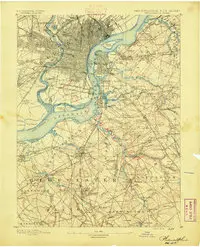
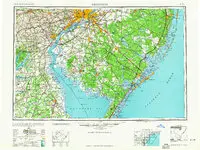
Old maps

Where it is
The circle shows the general area only. Open on the full map
Sources
- Room from the Powel House, Philadelphia — Internet Archive, 1765-01-01 · Public domain (pre-1929)
- Wikimedia Commons category : Powel House — Wikimedia Commons
- USGS 1:250000-scale Quadrangle for Wilmington, DE 1959 — U.S. Geological Survey, 1959 · Public domain (USGS)
- USGS 1:62500-scale Quadrangle for Philadelphia, PA 1891 — U.S. Geological Survey, 1891 · Public domain (USGS)
- "Peggy Shippen" — Wikipedia — Wikipedia
- "Powel House" — Philadelphia Society for the Preservation of Landmarks — Philadelphia Society for the Preservation of Landmarks
- Wikipedia article — Wikipedia · CC BY-SA 4.0
Text written by AI from the sources above and checked by a separate AI fact-check (how we work). Images: credits and licenses under each picture.
Spotted a mistake? Report an error