
Haunted place · New York, United States
New York State Capitol
Updated November 202615 sourcesHow to visit
- Protected heritage
- 5 archive documents
New York State Capitol, Albany: a vast 1899 statehouse where night watchman Samuel Abbott died in the 1911 fire and is said to still make his rounds.
The story
Albany became New York's capital in 1797. The legislature first met in the old Albany City Hall, then from 1812 in a first Capitol designed by local architect Philip Hooker, used until 1879. The present building, home to the State Legislature and set in Capitol Park on State Street as part of the Empire State Plaza complex, took 32 years to build, from 1867 to 1899. At a cost of $25 million it was the most expensive government building of its day.
Three successive architectural teams left their marks on it. The Englishman Thomas Fuller, who also designed Canada's Parliament buildings in Ottawa, began the work. By 1875 the original appropriation was spent, with the outer walls only two stories high. Lieutenant Governor William Dorsheimer brought in an advisory board of Frederick Law Olmsted, Leopold Eidlitz and Henry Hobson Richardson, and Fuller was dropped. Eidlitz and Richardson took over until Governor Grover Cleveland, alarmed by costs, dismissed them in 1883 and handed the project to Isaac G. Perry, who completed it. The result mixes styles floor by floor, with Richardson's Romanesque dominating the upper levels and the roof. Eidlitz designed the Assembly Chamber, with what was then the world's largest stone vault, while Richardson was responsible for the Senate Chamber, the Governor's suite, the first State Library and the Great Western Staircase, the carved "Million Dollar Staircase" decorated with busts of famous Americans.
The building's ambitions outran its foundations. A planned dome was never built because the weight was cracking the structure and pushing it downhill toward State Street; a 166-foot exterior Eastern Staircase was added to brace the front. The Assembly's great vault proved unstable and acoustically poor, and a false ceiling was installed to catch falling fragments, hiding William Morris Hunt's two vast murals, The Flight of Night and The Discoverer, which had already begun to flake from damp.
The defining disaster came on March 29, 1911. Around 2 a.m. a fire broke out in the Assembly library and spread into the State Library in the western part of the building. Officials blamed faulty wiring and one employee blamed careless smoking at a party, but Wikipedia notes the cause was never established. The flames destroyed roughly half a million books and 300,000 manuscripts, along with some 8,500 State Museum artifacts, including Seneca and other Iroquois objects. One man died: Samuel J. Abbott, a Civil War veteran of about 78 who worked as a night watchman (since 1895, according to a single source). Searchers found his body two days later, on March 31, in a cramped fourth-floor passage; in his pocket was the key to a locked door close by. The western side was afterward rebuilt in the Beaux-Arts style. (The National Register nomination gives the fire's year as 1913, apparently an error.)
The Capitol was listed on the National Register in 1971, included in the Lafayette Park Historic District in 1978, and named a National Historic Landmark in 1979. Its exterior was restored between 2000 and 2014.
The legend
The Capitol's ghost is Samuel Abbott, whom a volunteer guide has called the building's "semi-official" ghost. Staff who stay late describe what sounds like a watchman still on duty: keys jingling, doorknobs being tested, doors shutting and lights going off. When they look, nobody is there. The activity is placed on the upper floors, above all the fourth and fifth, near where his body was found. One source adds that some people say they have seen him.
When the stories began is unclear; no dated first report is known. An Associated Press piece on the fire's centenary in 2011 already mentioned the lore that Abbott walks the fourth floor, and by 2016 he was a fixture of official tours. That October, State Senator Catharine Young was told by a guide on a Capitol ghost tour that Abbott had perished close to her office and was still making his rounds. The anecdote led to a law sponsored by Young and Assemblywoman Patricia Fahy, and on March 29, 2018, the 107th anniversary of the fire, the state unveiled a plaque in his honor. In Young's words, Abbott had become more than a legend. Here, a ghost tour led directly to an official memorial for a forgotten worker.
Two other pieces of lore circulate on the tours. A former curator's letter describes odd effects of the fire, such as Iroquois ceremonial objects that escaped damage; this is told as eerie history, not as a sighting. And a small devil's head carved near the base of the Great Western Staircase is said to be a disgruntled stone carver's curse on the building.
The most skeptical voice comes from the man who leads the tours. Stuart Lehman (also spelled Stewart), a retired assistant curator, reports no paranormal experience of his own in the building, doubts the curse, and describes employees as "kind of evenly divided" on the ghost. He leaves visitors to make up their own minds. NY1 (2016) and WRGB CBS6 (2024) have covered the tours; no television ghost-hunting episode is known.
What remains today
The Capitol covers about five and a half acres and measures roughly 400 by 300 feet, a square of load-bearing masonry around a central courtyard with a tower at each corner. Its exterior is granite from Hallowell, Maine, and the interiors use marble cut by prisoners at Sing Sing. Rising 220 feet, it belongs to the small group of eleven American statehouses that have no dome. Inside, marble and mosaic corridors, the Senate and Assembly chambers and the Million Dollar Staircase remain the highlights; a skylight over the staircase, long covered, was reopened during the recent restoration. Tunnels link the building to the Empire State Plaza. The plaque to Samuel Abbott, unveiled in 2018, marks the human cost of the 1911 fire.
Visiting
The Capitol is a working government building that is open to the public. The New York State Office of General Services runs free guided tours on weekdays, and in the Halloween season it adds free "Capitol Hauntings" tours that combine the history of the 1911 fire with the ghost stories. They often fill up, so plan ahead. Remember that this is a working government building, so respect the offices and the people who work there. The Empire State Plaza next door also has an online feature on the hauntings and the fire.
The ghosts
Servant or worker
Samuel Abbott, the night watchman
Said to be Samuel J. Abbott (c. 1833-1911), Civil War veteran and Capitol night watchman, the only person killed in the fire of March 29, 1911
Late-working staff report the sounds of a watchman's round: jingling keys, doorknobs tried, doors closing and lights switched off, mostly on the fourth and fifth floors near where his body was found. Some claim to have seen him. A 2016 ghost-tour anecdote led to a state plaque in his honor in 2018.
- Footsteps
- Doors opening
- Strange lights
- Apparitions
First reported: By 2011 (AP, fire centenary); established on official tours by 2016. Reported by: Capitol staff; OGS Capitol Hauntings tours; NY1 (2016); WRGB CBS6 (2024); AP (2011); Sen. Catharine Young
Photographs


From the archives


Old maps
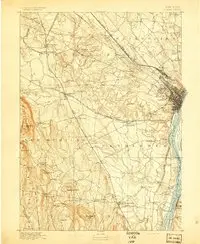
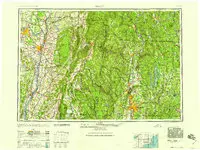
Where it is
The circle shows the general area only. Open on the full map
Sources
- National Register nomination #71000519 (texte intégral) — U.S. National Park Service · Public record
- National Register of Historic Places file (NRHP #71000519) — U.S. National Park Service · Public domain (U.S. government)
- Albany and the New York state capitol from original negatives by the Albertype co — Internet Archive, 1891-01-01 · Public domain (pre-1929)
- "Sparks" from the New York state capitol fire, Albany, N.Y., March 29, 1911. Over 50 souvenir views — Internet Archive, 1911-01-01 · Public domain (pre-1929)
- Wikimedia Commons category : New York State Capitol — Wikimedia Commons
- USGS 1:250000-scale Quadrangle for Albany, NY 1959 — U.S. Geological Survey, 1959 · Public domain (USGS)
- USGS 1:62500-scale Quadrangle for Albany, NY 1893 — U.S. Geological Survey, 1893 · Public domain (USGS)
- "NY marks 100th anniversary of 1911 Capitol fire" (2011) — NBC News / Associated Press — NBC News / Associated Press
- "Plaque Honoring Samuel Abbott Unveiled at New York State Capitol" (March 2018) — New York State Senate — New York State Senate
- "Samuel Abbott" (disambiguation: watchman, 1833–1911) — Wikipedia — Wikipedia
- Senate Bill S5570 (2017), commemorative plaque for Samuel J. Abbott — New York State Senate — New York State Senate
- "Spooky or historical? Uncover the mysteries of the New York State Capitol" (Olivia Jaquith, 31 Oct 2024) — WRGB CBS6 / CNY Central — WRGB CBS6 / CNY Central
- "State Capitol in Albany can be a spooky place" (Zack Fink, 29 Oct 2016) — NY1 / Spectrum News — NY1 / Spectrum News
- "Virtual Visit: Hauntings – Fire of 1911" — Empire State Plaza / NYS OGS (not read directly) — Empire State Plaza / NYS OGS (not fetched, seen in search only
- Wikipedia article — Wikipedia · CC BY-SA 4.0
Text written by AI from the sources above and checked by a separate AI fact-check (how we work). Images: credits and licenses under each picture.
Spotted a mistake? Report an error