
Haunted place · California, United States
Leonis Adobe
Updated November 202611 sourcesHow to visit
- As seen on Most Haunted
- Protected heritage
- 11 archive documents
An 1840s ranch house in Calabasas, California, now a museum, where Basque rancher Miguel Leonis is said to drop his boots upstairs and leave a scent of soap.
The story
The Leonis Adobe stands in Calabasas, at the western edge of the San Fernando Valley in Los Angeles County. It ranks among the oldest private houses left in the county and among the oldest buildings of any kind in the valley. Its beginnings are hazy: the 1975 National Register nomination notes that documents, since lost, dated its construction to 1844–46, when California was still part of Mexico, which would make it older than any surviving structure in the valley apart from the San Fernando Mission. What it was first built for is unknown; one suggestion is that it served as a stagecoach stop on El Camino Real. It is also one of just four adobe homes left in the Valley.
The house is tied to two remarkable people. Miguel Leonis, a Basque from Cambo-les-Bains in the French Basque country, reached Los Angeles in 1854 as a sheepherder. Wikipedia gives his birth year as 1824, while the museum's history says 1822. One account quoted on Wikipedia describes how he went from humble herder to something like a "robber baron," ruling his land with the help of a small army of vaqueros. He began as a hired hand on Rancho El Escorpión, about 1,100 acres in what is now West Hills, and bought half of it from its ailing owner. The other half belonged to Espiritu Chijulla (1836–1906), a widowed mission Indian whom the museum describes as being of Chumash and Gabrielino-Tongva descent. According to the National Register file, she was the daughter of Odon, who with his brothers had tended cattle for the San Fernando Mission and received the rancho when the mission lands were broken up. Leonis gained control of her land through their union, a marriage he would later deny. Under Leonis the holdings grew considerably, and in 1878 the couple made the Calabasas adobe their permanent home, with Leonis enlarging and remodeling it in the Monterey Colonial style.
Leonis died in 1889 after falling from his wagon and being run over near Cahuenga; contemporary reports blamed his unsteadiness on an excess of sour wine. His will called Espiritu his "faithful housekeeper," left her $10,000, and sent the rest of his fortune to his siblings and relatives in France. She fought back. At an 1891 jury trial, 40 witnesses testified that Leonis had openly treated her as his wife; Espiritu told the court they had met in 1859 at the Escorpion Indian camp, lived together for 30 years, and had a daughter who died young, whose grave named Leonis as father. After five weeks, the jury needed less than a day to award her half the estate.
Her troubles were far from over. The estate spawned more than 100 lawsuits, swindlers circled, and a young Hollywood tavern keeper persuaded her to sign all her property over to him. At one low point, it was said, she was reduced to eating acorns gathered at her home. The Los Angeles press covered every twist with a condescending, often mocking tone, especially when, at 65, she married an 18-year-old. After a battle the National Register file puts at sixteen years, the litigation ended in her favor in 1905, and she died at the adobe the following year, only months after her victory. Her son from her first marriage, Juan Menendez, then moved in with his family; a blacksmith and winemaker, he built the barn behind the house and the tank house where he stored his wine.
The legend
Most of the ghost lore here comes from a single line of sources: Leonis's biographer Laura B. Gaye (1905–1981) and a pair of pieces Martha Willman wrote for the Los Angeles Times in 1971 and 1978, as summarized on Wikipedia. The museum that runs the adobe today does not promote ghost stories at all. With that caveat, the tradition is consistent and goes back further than most.
According to Gaye, the first accounts date from the 1920s, when the house first passed to occupants who were not Leonis kin and began remodeling it. The newcomers heard footsteps climbing the stairs, then two heavy thumps from the upstairs bedroom, like a man pulling off his boots and letting them fall. When they went up, the room smelled strongly of soap. That detail is the signature of the story: Leonis was remembered as fastidiously clean, a man who always smelled of soap. The noises kept coming, and the household decided the old owner was still in residence and learned to put up with him.
Later stories add to the picture. In the 1930s, the legend says, a woman living in the house was leaning on a railing when it cracked, and something she could not see drew her back before she fell. A guest is said to have seen a figure on the upper landing that called out in a woman's voice, repeating "Chichita, Chichita"; Espiritu's granddaughter later explained that this was the pet name her grandmother used for her, which is why some link the apparition to Espiritu. A young Calabasas resident claimed to have seen Leonis himself, strolling with his sheepdog near the adobe, dressed in a coat of another era. And there are tales of digging sounds from inside the house, tied to a legend that Leonis hid his fortune there.
The adobe's best-known media appearance is the British series Most Haunted, which filmed its episode "Leonis Adobe" there for series 6, episode 18, broadcast on Living TV on July 27, 2005. Huell Howser also featured the adobe on his PBS program Visiting... with Huell Howser in January 2010, but that visit was about history, not ghosts. No skeptical study of the claims is known, and no first-hand account survives beyond those relayed by Gaye and the Times.
What remains today
The house is a two-story adobe in the Monterey style, with a pitched shingle roof, porches on both levels around three sides, and a foundation of local Calabasas fieldstone. Restorers returned it to the look it had once Leonis finished reworking it in the late 1870s, considered its finest period. Because later owners mostly added to the building rather than tearing into it, the restoration was largely a matter of uncovering, and the National Register nomination stresses that a very high proportion of the fabric is original. Details include redwood paneling over whitewashed adobe walls, mid-19th-century hardware with porcelain doorknobs, and shutters whose cast-iron hinges are stamped with an 1843 patent date. Its white walls and red-and-blue trim follow color research done during the restoration.
Around it, the grounds recreate a working ranch: Menendez's barn, dated to 1912 and since moved twice to make way for the 101 Freeway, which houses a smithy and an old threshing machine, along with a rebuilt windmill, well, tank house, bake oven, grape arbor, dovecote and coops, based on early photographs and watercolors. Saved from demolition in 1962, when its owner had sought to replace it with a supermarket after years of vandalism, it was declared Los Angeles Historic-Cultural Monument No. 1 on August 6, 1962, the very first on a list that has since grown to hundreds. The Leonis Adobe Association bought the property in 1965 and opened it to visitors in 1966, and National Register listing followed in 1975.
Visiting
The Leonis Adobe is a living history museum in Calabasas, run by the Leonis Adobe Association and devoted to California ranch life in the 1880s. A visit takes in the furnished adobe, the ranch buildings and farm animals, and the Plummer House, which serves as the visitor center. It is a popular destination for school field trips.
Check the museum's official website before you go. The museum advertises no ghost tours or Halloween ghost events, so come for the history, and follow staff instructions around the historic rooms and the animals.
The ghosts
Spirit
Miguel Leonis
Said to be Miguel Leonis (1822 or 1824-1889), Basque rancher known as the 'King of Calabasas', who lived in and remodeled the adobe
The first residents from outside the family, in the 1920s, heard steps on the stairs and two boot-like thumps upstairs, then found the room smelling of soap, a scent linked to the very clean Leonis. A young local later said he saw Leonis in an old-style coat walking his sheepdog near the house.
- Footsteps
- Smells
- Apparitions
First reported: 1920s. Reported by: Laura B. Gaye (biographer); Martha Willman, Los Angeles Times (1971, 1978); Most Haunted S06E18 (2005)
The "Chichita" voice
Said to be Possibly Espiritu Chijulla (1836-1906); the word matches the pet name she used for her granddaughter
A guest is said to have seen a figure in the upstairs hall that called out "Chichita, Chichita" in a woman's voice. Espiritu's granddaughter said her grandmother had called her by that name.
- Apparitions
- Voices
Reported by: Via Wikipedia (Gaye / Los Angeles Times)
Spirit
The railing rescuer
In the 1930s, legend says, a resident leaned on a railing that gave way and was pulled back to safety by an invisible hand.
- Being touched
First reported: 1930s.
Photographs


From the archives


Old maps
Investigated on TV
- Most Haunted · Season 6, episode 18 — “Leonis Adobe”2005
Where it is
The circle shows the general area only. Open on the full map
Sources
- National Register nomination #75000433 (texte intégral) — U.S. National Park Service · Public record
- National Register of Historic Places file (NRHP #75000433) — U.S. National Park Service · Public domain (U.S. government)
- Wikimedia Commons category : Leonis Adobe — Wikimedia Commons
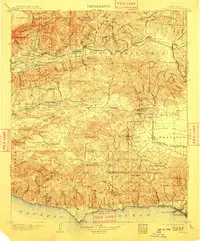
- USGS 1:125000-scale Quadrangle for Camulos, CA 1903 — U.S. Geological Survey, 1903 · Public domain (USGS)
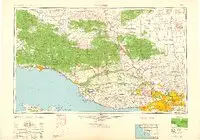
- USGS 1:250000-scale Quadrangle for Los Angeles, CA 1959 — U.S. Geological Survey, 1959 · Public domain (USGS)
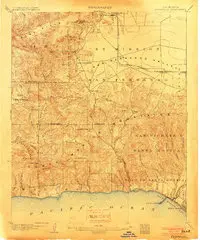
- USGS 1:62500-scale Quadrangle for Calabasas, CA 1903 — U.S. Geological Survey, 1903 · Public domain (USGS)
- home page — Leonis Adobe Museum (official) — Leonis Adobe Museum (official
- "List of Most Haunted episodes" — Wikipedia — Wikipedia
- "No. 1 - Leonis Adobe" — Big Orange Landmarks (Floyd B. Bariscale, 10 Mar 2007) — Big Orange Landmarks (Floyd B. Bariscale, 10 Mar 2007
- "Our History" — Leonis Adobe Museum (official) — Leonis Adobe Museum (official
- Wikipedia article — Wikipedia · CC BY-SA 4.0
Text written by AI from the sources above and checked by a separate AI fact-check (how we work). Images: credits and licenses under each picture.
Spotted a mistake? Report an error