
Haunted place · Scotland, United Kingdom
Borthwick Castle
Updated November 202611 sourcesHow to visit
- Protected heritage
- 2 archive documents
Towering 1430 keep in Midlothian where Mary, Queen of Scots fled a siege in disguise; its Red Room is tied to a murdered servant girl and her baby.
The story
Borthwick Castle rises on a site just east of the village of Borthwick in Midlothian, about twelve miles southeast of Edinburgh, guarded on three sides by steeply falling ground. It counts among the largest and best-preserved medieval fortresses still standing in Scotland.
Its builder was Sir William Borthwick, later the first Lord Borthwick. On June 2, 1430, King James I granted him a licence to raise a castle or fortalice on the Mote of Locherwart, where an earlier building had stood. Royal permission of this kind was unusual in Scotland, where nobles generally fortified their houses without asking. Sir William had acquired much of the surrounding land from his neighbor William Hay, who is said to have resented the deal and envied the castle that followed. The builder and his wife are commemorated by well-preserved medieval effigies in the nearby parish church of St Kentigern, which keeps a fifteenth-century aisle probably also of his making.
The castle began as a walled stone enclosure around an exceptionally tall tower house. The keep is U-shaped, its two slightly unequal towers separated by a gap of twelve feet, with walls up to fourteen feet thick rising to about 110 feet. A defensive courtyard surrounded it, with round corner towers pierced by gun loops.
Borthwick's history is full of intrigue. In September 1544, during the Anglo-Scottish war known as the Rough Wooing, John, 5th Lord Borthwick, was seized and held at Dalkeith Castle. His wife, Isobel Lindsay, retaliated by luring Patrick Hepburn, 3rd Earl of Bothwell, to the castle as a guest and keeping him prisoner until her husband was freed in an exchange. A spy reporting to the English officer William Eure offered a gossipy explanation: Bothwell had come because "the Lady Borthwick is fair, he came to her for love, but she made him to be handled and kept."
The castle's most famous guest was Mary, Queen of Scots, who visited in August 1563 and October 1566. After the murder of her second husband, Lord Darnley, she wed James Hepburn, 4th Earl of Bothwell, on May 15, 1567, and the following month the couple took refuge at Borthwick. On June 11 hostile nobles under Lord Home and the laird of Cessford encircled the castle. Bothwell slipped out first and made for Dunbar, while his young companion, the laird of Crookston, was captured. According to the diplomat William Drury, the besiegers hurled insults at the walls and Mary shouted back. She then escaped disguised as a male page and rejoined her husband. Within weeks she was captured at Carberry Hill and imprisoned at Lochleven Castle, while Bothwell fled to Orkney, Shetland and finally Norway, then under Danish rule, where he ended up in captivity; he died in 1578.
In 1650 Oliver Cromwell's forces bombarded Borthwick, and the garrison surrendered after only a few cannon shots; one account says three towers were destroyed and that Lord Borthwick gave up on November 18. According to the castle's own history, no member of the family lived there again until 1810. After a long period of neglect, a major restoration was completed in 1913 or 1914, and during the Second World War the castle was used to hide national treasures. In 1973 it was leased and turned first into a conference center and then into a hotel, and it later became an exclusive-hire venue. It closed for a major refurbishment in June 2013 and reopened in September 2015.
The legend
Wikipedia says only that Borthwick is the setting for local ghost stories, one involving Mary, Queen of Scots. Fuller accounts exist, but it is worth knowing where they come from. The earliest reliable written version found for this page is a 1997 feature in the magazine British Heritage, which already presents the tales as "legend" and "gossip" rather than history. No earlier dated report has been found.
The central story belongs to the Red Room. A young servant girl is said to have given birth there to the illegitimate son of a Borthwick. Because the child could threaten the inheritance of the title, mother and baby were reportedly killed. Some ghost websites call her "Ann Grant" and claim she died of a knife wound to the belly, but that name and those details do not appear in any reliable source and may be later embellishments.
The Red Room is also linked to a second figure, the family chancellor, who once used the room as his office; the niches of his wall safes can still be seen. According to the gossip recorded in 1997, he had been embezzling, and the Borthwicks intercepted him on his way home from Edinburgh and burned him to death. He is said to climb the spiral stairs together with the servant girl.
The Red Room's reputation reportedly grew so troublesome, frightening so many guests, that the people running the castle called in a priest from Edinburgh to exorcise it. No date or name is attached to the exorcism. The Great Hall has its own stories: British Heritage wrote that even the sturdiest visitors had felt unseen presences there, and the Edinburgh city tourism website lists Borthwick among its haunted places to stay, mentioning voices, clicking noises and unexplained flashes of light in the Great Hall and the Red Room. Ghost directories add disembodied voices, a sense of unease and full apparitions, while stories of a scratching sound near the bed and of chilly patches in the Red Room circulate only on ghost websites.
Mary, Queen of Scots, roams the corridors after dark, according to the same tourism site. Her stay, the siege and her escape in disguise are well documented; the ghost is not, and it rests on a single tourism source. No television investigation of the castle has been found. A 1980 BBC Spine Chillers episode titled "The Red Room" is sometimes linked to Borthwick, but it adapts an H. G. Wells story set in a fictional castle and has nothing to do with this one.
What remains today
The great tower house survives in remarkable condition for a building of the 1430s, while the surrounding curtain wall and corner towers have been extensively restored. Marks left by Cromwell's cannon in 1650 are still visible on the masonry. The castle is a Category A listed building, Scotland's highest level of protection. Inside, the Great Hall and the Red Room, with the chancellor's wall-safe niches, are the spaces most associated with the legends. The castle's own website presents its history but does not mention the ghosts at all.
Visiting
Borthwick Castle is a private exclusive-hire venue for weddings, events and stays, not a monument with public opening hours. Access is only for those who book through the official website, and visitors should not enter the grounds uninvited. No ghost tour is offered.
There are good legal ways to see it. Trains on the Borders Railway, which links Edinburgh Waverley with Tweedbank, pass close enough to give passengers a panoramic view of the castle. The nearby parish church of St Kentigern, with the medieval effigies of the castle's builder and his wife, offers a direct link to its fifteenth-century origins.
The ghosts
Mary, Queen of Scots
Said to be Mary, Queen of Scots, besieged at Borthwick in June 1567
The Edinburgh tourism site says she wanders the halls at night. Her 1567 stay and escape disguised as a page are historical; the ghost claim rests on a single source.
- Apparitions
Reported by: Forever Edinburgh (edinburgh.org)
The baby of the Red Room
Said to be Illegitimate son of a Borthwick, according to legend
The child said to have been killed with his mother in the Red Room. No separate manifestations are described.
First reported: By 1997. Reported by: British Heritage (1997)
Servant or worker
The chancellor
Said to be The family chancellor who used the Red Room, said to have been embezzling
Gossip says he was caught embezzling, and that the Borthwicks intercepted him on his way home from Edinburgh and burned him to death. He is said to climb the spiral stairs alongside the servant girl.
- Apparitions
First reported: By 1997. Reported by: British Heritage (1997); Higgypop
Servant or worker
The servant girl of the Red Room
Said to be A young servant said to have borne an illegitimate son to a Borthwick (the name 'Ann Grant' appears only on unreliable websites)
She and her baby are said to have been killed in the Red Room because the child threatened the succession to the title. Legend pairs her with the chancellor's ghost on the spiral stairs. The room was reportedly exorcised by an Edinburgh priest after frightening many guests.
- Apparitions
- Voices
First reported: By 1997 (British Heritage feature). Reported by: British Heritage (1997); Forever Edinburgh tourism site
Photographs


From the archives

Where it is
The circle shows the general area only. Open on the full map
Sources
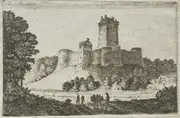
- Borthwick Castle from the East — Internet Archive · John Clerk of Eldin (British, 1728–1812), 1770-01-01 · https://creativecommons.org/publicdomain/zero/1.0/
- Borthwick Castle, near Duns: excavations, 1979 [of a late 16th century towerhouse], Volume 111, 430-44 — Archaeology Data Service via Europeana, 1981 · http://rightsstatements.org/vocab/InC-EDU/1.0/
- Borthwick castle, or, Sketches of Scottish history [microform] : with biographical notices of the chiefs of the house of Argyll — Internet Archive · Borthwick, J. Douglas (John Douglas), 1832-1912, 1880-01-01 · Public domain (pre-1929)
- Borthwick Castle; or, Sketches of Scottish history. With biographical notices of the chiefs of the house of Argyll — Internet Archive · Borthwick, J. Douglas (John Douglas), 1832-1912, 1880-01-01 · Public domain (pre-1929)
- Wikimedia Commons category : Borthwick Castle — Wikimedia Commons
- "Borthwick Castle - Haunted History" — Higgypop — Higgypop (ghost directory, no sources cited).
- "History" — Borthwick Castle (official site). — Borthwick Castle (official site).
- Official website
- "The Ins and Outs of Borthwick Castle" — British Heritage Travel (Betsa Marsh, Oct/Nov 1997, online 23 Sept 1997). — British Heritage Travel (Betsa Marsh, Oct/Nov 1997, online 23 Sept 1997).
- "Top haunted hotels in Edinburgh" — Forever Edinburgh / edinburgh.org (city tourism site). — Forever Edinburgh / edinburgh.org (city tourism site).
- Wikipedia article — Wikipedia · CC BY-SA 4.0
Text written by AI from the sources above and checked by a separate AI fact-check (how we work). Images: credits and licenses under each picture.
Spotted a mistake? Report an error