
Haunted place · Scotland, United Kingdom
Holyrood Palace
Updated November 202626 sourcesHow to visit
- Protected heritage
- 3 archive documents
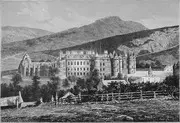
Holyrood Palace, the royal residence at the foot of Edinburgh's Royal Mile, where David Rizzio was murdered in 1566 and legend says his bloodstain returns.
The story
The Palace of Holyroodhouse sits at the foot of Edinburgh's Royal Mile, at the opposite end from the castle, with its gardens set within Holyrood Park. It has been the monarch's principal residence in Scotland since the sixteenth century and remains the official royal home in the Scottish capital.
The site began as a monastery. King David I founded the Augustinian Holyrood Abbey in 1128, and its name may recall a cross the king saw in a legendary vision, or a fragment of the True Cross, the Holy Rood or Black Rood, once owned by his mother, Saint Margaret. Close to the castle and under royal patronage, the abbey became a center of government: the Scottish Parliament met there several times between 1256 and 1410, Robert the Bruce signed the Treaty of Edinburgh-Northampton there in 1328, and kings were born, married and buried within its walls. Royal lodgings first occupied the abbey guesthouse and by the later fifteenth century had become a residence in their own right. The abbey church now stands roofless beside the palace.
The palace's most notorious night came in the reign of Mary, Queen of Scots. At about 8 p.m. on March 9, 1566, her husband Henry Stuart, Lord Darnley, and a group of Protestant nobles led by Lord Ruthven climbed the private stair from Darnley's rooms and forced their way into the small room where the queen was having supper. They seized her Italian secretary, the musician David Rizzio (or Riccio), dragged him through the royal bedroom to the outer room of James V's Tower, and knifed him to death there, reportedly 57 times. Rizzio was first buried in the abbey graveyard; the historian George Buchanan wrote that his body was later moved into the royal tomb. Less than a year later, on February 10, 1567, Darnley himself was killed, not at Holyrood but at Kirk o' Field elsewhere in the city.
Holyrood also witnessed the witch panic of the 1590s. Agnes Sampson, a healer and midwife from Keith known as the "Wise Wife of Keith," was accused in the North Berwick witch trials. According to Newes from Scotland, a pamphlet printed in 1591, she was examined in front of James VI at Holyrood. She was indicted on 53 counts on January 27, 1591, and was strangled and burned on Castlehill the next day.
The present palace was completed in 1679 to designs by William Bruce. Its Great Gallery, about 150 feet long, holds 96 of the 111 portraits of Scottish kings, real and mythical, that Jacob de Wet painted in 1684-1686. Bonnie Prince Charlie held evening balls there during his brief occupation of the city, defeated government troops were quartered there after Falkirk Muir in January 1746, and the exiled Charles X of France lived at Holyrood from 1830 to 1832. When George IV visited in 1822 he ordered repairs but insisted that Queen Mary's rooms be protected from future alteration.
The legend
Today Holyrood's ghost lore is drawn from royal-news features, local radio and Edinburgh tour companies. The Royal Collection Trust, which runs visits, does not appear to promote any of it, so these are legends rather than claims made by the palace.
David Rizzio is the ghost most closely tied to the building. Tradition places his ghost in the tower rooms where he died, and writers describe unexplained noises late at night and a figure at the murder site. The best-known element is the bloodstain: a reddish or dark mark on the floor near a small plaque in the outer chamber, which tradition says returns however often it is scrubbed, even when the boards have been replaced. Royal Central attributes the story of the floorboards to palace staff. The mark has been part of the visitor experience for a long time; Wikipedia cites a guidebook describing it as the "alleged bloodstain," and accounts differ on details: some add that Rizzio's body was thrown down a staircase after the stabbing.
Lord Darnley, who took part in the conspiracy against Rizzio, is said to have been seen many times in and around his former rooms. His death took place across the city at Kirk o' Field, so any haunting at Holyrood would be of the scene of his crime rather than of his own end.
The most disturbing figure is "Bald Agnes," identified with Agnes Sampson. Her head and body were shaved during her interrogation in a search for the so-called devil's mark, which explains the nickname. Accounts disagree on where she appears: Royal Central places her, naked and bearing the marks of torture, in the palace corridors, while a 2026 Forth 1 feature puts her in the gardens. Some features also give the wrong year for her death, 1592 rather than 1591. The same radio piece claims Mary, Queen of Scots, herself has been seen, and an old newspaper, below, says the same.
Edinburgh's well-known tale of a lost piper, whose music is said to drift up from a tunnel running between the castle and the palace, belongs to the Royal Mile in general rather than to Holyrood itself.
The oldest report we found is a feature headed "Haunted Palaces" in the New-York Tribune of November 19, 1893 (the scan reads "Hollywood" for the palace), repeated in The Morning News of Savannah on October 15, 1898, with the name clear: "the ghost of the murdered Rizzio" is "supposed to promenade the gloomy old galleries after dark." That puts him in the galleries rather than the tower rooms. The Evening Star of Washington printed "Haunted Holyrood" on July 1, 1901, from the London Chronicle. "Some twenty years ago," it said, the late Countess of Caithness, a spiritualist, spent the night in Mary's apartments, went to the chapel and met the queen's apparition "holding her severed head in her hands," which answered the charges against her. The porter then locked the countess in his lodge for the night.
No television investigation is known. Holyrood is a working royal residence, which makes it an unlikely place for paranormal filming. Historians would also note that the Rizzio murder and the witch trials are thoroughly documented, while the ghost stories built on them are not.
What remains today
The palace is still used for state occasions; the King spends a week in residence each early summer, and the Lord High Commissioner, the Crown's representative at the Church of Scotland's annual General Assembly, stays there while it sits, a custom dating from 1834. Mary, Queen of Scots' sixteenth-century apartments in James V's Tower survive, with the supper room and outer chamber where Rizzio died on the visitor route and the plaque marking the spot. The State Apartments, the Great Gallery with de Wet's portraits and the Tam o' Shanter Chair made from the roof timbers of Alloway Auld Kirk can also be seen. The ruined abbey church stands beside the palace, and the King's Gallery, opened in 2002 at the western entrance, shows works from the Royal Collection. The building is Category A listed.
Visiting
Holyrood is open to visitors through the Royal Collection Trust for most of the year, closing only while the royal family is staying there; check dates and tickets on the official Royal Collection Trust website before going. The State Apartments and the historic apartments of Mary, Queen of Scots, including the rooms associated with Rizzio's murder, are on the visitor route.
We found no ghost tours inside the palace and no paranormal investigations. Several Edinburgh ghost-walk companies, such as Mercat Tours, tell the Rizzio story on walks along the Royal Mile, outside the palace.
The ghosts
Bald Agnes
Said to be Agnes Sampson, the 'Wise Wife of Keith', executed 28 January 1591 in the North Berwick witch trials
Agnes was shaved in a search for the devil's mark, hence the nickname. Her ghost is described naked and bearing the marks of torture, in the corridors according to one source and in the gardens according to another.
- Apparitions
Reported by: Royal Central (2022); Forth 1 (2026)
Spirit
David Rizzio
Said to be Italian musician and secretary to Mary, Queen of Scots, murdered at Holyrood on 9 March 1566
Tradition places his ghost in the tower rooms where he died, with unexplained sounds at night and a figure seen at the scene of the murder. A bloodstain near the plaque is said to reappear no matter how often it is cleaned or the floor replaced.
- Apparitions
Reported by: New-York Tribune (1893); The Morning News (1898); Royal Central (2022); Mercat Tours
Spirit
Lord Darnley
Said to be Henry Stuart, Lord Darnley, Mary's husband and a party to the plot against Rizzio
Darnley is said to have been seen many times around his former quarters. He died at Kirk o' Field in 1567, not at the palace.
- Apparitions
Reported by: Royal Central (2022); Forth 1 (2026)
Mary, Queen of Scots
Said to be Mary, Queen of Scots
A 2026 radio feature says the queen herself has been sighted at the palace. In 1901 the Evening Star of Washington told of the Countess of Caithness meeting her apparition about twenty years earlier, "holding her severed head in her hands."
- Apparitions
Reported by: Evening Star (1901); Forth 1 / Rayo (2026)
Photographs


From the archives

Old maps

Where it is
The circle shows the general area only. Open on the full map
Sources
- Holyrood Palace — Internet Archive · GadoImages.com, 1881-01-01 · Public domain (pre-1929)
- Wikimedia Commons category : Holyrood Palace — Wikimedia Commons
- "4 of Edinburgh's most haunted places" (Vinnie Kaur Reid, 18 Feb 2026) — Forth 1 / Rayo (Bauer radio) — Forth 1 / Rayo (Bauer radio
- "Agnes Sampson" — Wikipedia — Wikipedia
- "David Rizzio" — Wikipedia — Wikipedia
- Edinburgh, Holyrood Palace. Tourists of the Hapag during the visit of Holyrood Palace, here probably the ruins of the castle church — Deutsche Fotothek via Europeana · http://creativecommons.org/publicdomain/mark/1.0/
- Edinburgh, Holyrood Palace. Tourists of the Hapag during the visit of Holyrood Palace, here probably the ruins of the castle church — Deutsche Fotothek via Europeana · http://creativecommons.org/publicdomain/mark/1.0/
- Edinburgh/ Schottland. Holyrood Palace mit Brunnen — Deutsche Fotothek via Europeana · http://creativecommons.org/publicdomain/mark/1.0/
- Edinburgh, Schottland. Militärparade schottischer Gardisten vor dem Holyrood Palace — Deutsche Fotothek via Europeana · http://creativecommons.org/publicdomain/mark/1.0/
- Edinburgh/ Schottland. Schottische Gardisten vor dem Eingang von Holyrood Palace — Deutsche Fotothek via Europeana · http://creativecommons.org/publicdomain/mark/1.0/
- Edinburgh (Schottland). Touristen vor dem Haupteingang von Holyrood Palace — Deutsche Fotothek via Europeana · http://creativecommons.org/publicdomain/mark/1.0/
- Edinburgh/ Schottland: Westflügel des Holyrood Palace mit Brunnen — Deutsche Fotothek via Europeana · http://creativecommons.org/publicdomain/mark/1.0/
- Edinburgh/Scotland: Tourists visiting Holyrood Palace — Deutsche Fotothek via Europeana · http://creativecommons.org/publicdomain/mark/1.0/
- Holyrood Palace — Rijksmuseum via Europeana · http://creativecommons.org/publicdomain/mark/1.0/
- Holyrood Palace — Deutsche Fotothek via Europeana · http://rightsstatements.org/vocab/InC-EDU/1.0/
- Holyrood Palace — Deutsche Fotothek via Europeana, 1498 · http://creativecommons.org/publicdomain/mark/1.0/
- Holyrood Palace — Deutsche Fotothek via Europeana · http://creativecommons.org/publicdomain/mark/1.0/
- Holyrood Palace — Deutsche Fotothek via Europeana · http://creativecommons.org/publicdomain/mark/1.0/
- Holyrood Palace — Deutsche Fotothek via Europeana · http://creativecommons.org/publicdomain/mark/1.0/
- "Legends of eerie Edinburgh" — Mercat Tours (Edinburgh tour company) — Mercat Tours (Edinburgh tour company
- Mit MPi bewaffnete Polizistin bewacht Eingang zu Holyrood Palace, Tagungsort Gipfeltreffen — Deutsche Fotothek via Europeana · http://rightsstatements.org/vocab/InC-EDU/1.0/
- Official website
- Police officer armed with MPi guards Holyrood Palace, Edinburgh, summit meeting place — Deutsche Fotothek via Europeana · http://rightsstatements.org/vocab/InC-EDU/1.0/
- Side view of the new Scottish Parliament building in Edinburgh, near Holyrood Palace — Deutsche Fotothek via Europeana · http://rightsstatements.org/vocab/InC-EDU/1.0/
- "The royal ghosts of Holyroodhouse" (Susan Bowery, 27 Oct 2022) — Royal Central — Royal Central
- Wikipedia article — Wikipedia · CC BY-SA 4.0
Text written by AI from the sources above and checked by a separate AI fact-check (how we work). Images: credits and licenses under each picture.
Spotted a mistake? Report an error