
Haunted place · Kansas, United States
Stull, Kansas
Updated November 20269 sourcesHow to visit
- 3 archive documents
A tiny Kansas settlement whose cemetery became a famous "gateway to Hell" after a 1974 student newspaper article. The true story, the myths, and why not to go.
The story
Stull is a tiny unincorporated community in Douglas County, Kansas. Settlers arrived in the mid-1850s. The Kansas City Star says German immigrants founded it in 1856, Legends of Kansas counts six families there by 1857, and Wikipedia gives 1857. The settlers called it Deer Creek, and Wikipedia describes them as Pennsylvania Dutch. The name Stull came later, and only briefly: a post office ran from 1899 to 1903, and its only postmaster was Sylvester Stull.
Religion held the community together. An Evangelical Emmanuel congregation formed in 1859, and in 1867 it built a stone church on land given by Jacob Hildenbrand. Sermons there were preached in German until 1908. Nearby lies the cemetery that would later make Stull famous. Stull never became a real town and was never incorporated, so it never had a mayor, which matters for one of the legends below. By 2018 only a few buildings were left. The KC Star put the population at about 20 people, and the Stull Community of Faith church nearby still holds services.
The old stone church was eventually abandoned and stood for decades as a roofless shell. In March 2002 a windstorm brought down its west wall, and about two weeks later, around March 29, someone pushed the remaining walls over. The Lawrence Journal-World reported that the landowner said he had not authorized the demolition, and nobody ever publicly said who did it.
The legend
Stull is not haunted in the usual sense. There is no named ghost and no tragic family story. What it has is one of the best-known devil legends in America, and in this case the origin can be traced.
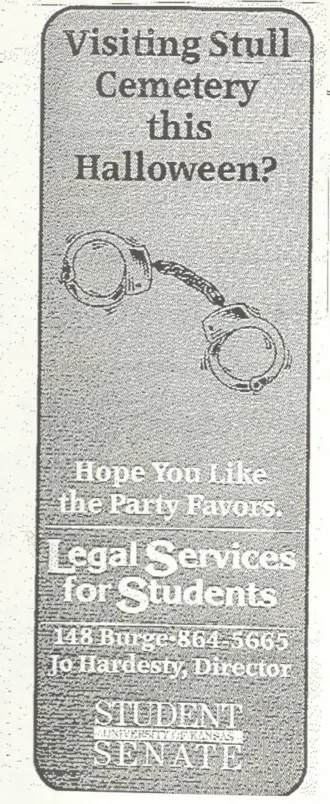
On November 5, 1974, the University of Kansas student newspaper, the University Daily Kansan, ran a piece by student writer Jain Penner titled "Legend of Devil Haunts Tiny Town." Its claim: Satan showed up at the Stull graveyard on two nights each year, Halloween and the spring equinox. Lawrence historian Paul Thomas, who writes about Stull in his 2017 book Haunted Lawrence, says a paper shortage held the article back until after Halloween. As a result, what was probably intended as a Halloween feature read like a news report.
The story grew quickly through retelling. Soon the graveyard was being called one of Hell's "seven gates," and attention later moved to the ruined church, where a hidden staircase supposedly led down to Hell. Witches were added: a tree in the graveyard was said to have been a gallows for them. Thomas notes that a headstone carved with the family name "Wittich" was misread as evidence of a witch. Other versions blamed the legend on the murder of Stull's mayor in the 1850s, which is impossible because the community never had a mayor. A persistent rumor says John Paul II ordered his pilots to steer around Stull's airspace. Accounts disagree on whether this was a 1980s trip or a 1990s visit to Colorado, and Jay Armbrister, the Douglas County sheriff, has dismissed it as untrue. The KC Star mentions one possibly real dark event, a suicide by hanging from one of the graveyard's trees, supposedly around 1900, but only one source reports it.
Visitors who went looking for the Devil came back with stories of strange noises, memory lapses and "omens," such as bottles thrown against the church walls that did not break. No investigation has documented any of this, and no credible paranormal TV investigation of Stull is known.
Pop culture kept the story going. Urge Overkill put the church on the cover of their 1992 record Stull. The films Turbulence 3: Heavy Metal (2001) and Nothing Left to Fear (2013) used the legend. The cemetery is the setting for the season five finale of Supernatural, "Swan Song," and the show's creator Eric Kripke said in 2006 that he made the Winchester brothers come from Lawrence because it is close to Stull. In a 2013 interview with Complex, Ariana Grande described a frightening experience there, and Kurt Cobain spoke in a 1992 interview of having gone there one night. The claim that The Cure canceled a Kansas show because of Stull is false.
Historians, academics and local residents largely agree that the legend has no historical basis and was started and spread by students. It has also caused real harm. Over the years trespassers knocked down headstones and fences, and residents of a community where burials still take place grew tired of drunk visitors. Thomas says the legend "sort of lost some of its power" after the church came down, and in 2024 the KC Star described it as "dying a slow death."
What remains today
Stull Cemetery is still a working burial ground. The stone church that featured in so many retellings is gone, demolished in 2002. Only a few buildings remain in the community, along with the active Stull Community of Faith church. The graveyard was damaged during the decades of Halloween visits, and it is now locked, fenced and posted with no-trespassing signs.
Visiting
Do not visit the cemetery. It is private, locked and fenced, and the Douglas County Sheriff's Office patrols it, especially around Halloween. People caught inside after hours have been arrested. Wikipedia mentions penalties that can reach a $1,000 fine and half a year behind bars, and the KC Star says trespassers can be held overnight until they see a judge. No legitimate ghost tour goes there. Remember that families still bury and visit their relatives in this cemetery. If you are interested in the legend, Paul Thomas's Haunted Lawrence tells the story better than a night at the gate, and nearby Lawrence has the university where the legend began.
The ghosts
Spirit
The Devil of Stull Cemetery
Said to be Satan, in the legend
The legend says the Devil appears in the cemetery on Halloween and the spring equinox, and that the graveyard, or the ruined church, is one of the seven gates to Hell. Local historians date the tale to a 1974 campus newspaper piece and see nothing historical behind it.
- Apparitions
First reported: 1974 (University Daily Kansan, 5 November). Reported by: University Daily Kansan (1974); thrill-seekers; Paul Thomas, Haunted Lawrence (2017, skeptical)
Spirit
Witches of the gallows tree
Later retellings said a cemetery tree had been used to hang witches who return each year. Historian Paul Thomas links the idea to a misread 'Wittich' family headstone.
First reported: after 1974. Reported by: Local lore; Paul Thomas (skeptical)
Photographs



Old maps
Where it is
The circle shows the general area only. Open on the full map
Sources
- Wikimedia Commons category : Stull, Kansas — Wikimedia Commons
- USGS 1:125000-scale Quadrangle for Lawrence, KS 1885 — U.S. Geological Survey, 1885 · Public domain (USGS)
- USGS 1:24000-scale Quadrangle for Clinton, KS 1955 — U.S. Geological Survey, 1955 · Public domain (USGS)
- USGS 1:250000-scale Quadrangle for Lawrence, KS 1956 — U.S. Geological Survey, 1956 · Public domain (USGS)
- "Ariana Grande saw Satan there? Legend of Stull Cemetery in Kansas is dying a slow death" (Lisa Gutierrez, 28 Oct 2024) — Kansas City Star (via AOL) — Kansas City Star (via AOL
- "Building's demolition a mystery" (30 Mar 2002) — Lawrence Journal-World — World
- "Haunted Lawrence" (Paul Thomas) — Arcadia / The History Press (not read directly) — Arcadia / The History Press (publisher listing, via search; not fetched
- "Stull, Kansas" — Legends of Kansas — Legends of Kansas
- Wikipedia article — Wikipedia · CC BY-SA 4.0
Text written by AI from the sources above and checked by a separate AI fact-check (how we work). Images: credits and licenses under each picture.
Spotted a mistake? Report an error