
Haunted place · New Mexico, United States
KiMo Theater
Updated November 202610 sourcesHow to visit
- Protected heritage
- 5 archive documents
A 1927 Pueblo Deco movie palace on Route 66 in Albuquerque, said to be haunted by a boy killed in a 1951 lobby explosion, a tale a skeptic has picked apart.
The story
The KiMo occupies a downtown Albuquerque street corner where Fifth Street meets Central Avenue, on the old line of Route 66. It is one of the most distinctive movie palaces of the 1920s, built in a style that came to be called Pueblo Deco: the stepped, softly rounded massing of New Mexico's adobe pueblos combined with the vertical thrust and repeated lines of Art Deco skyscrapers, and covered in Native American motifs.
The theater was the project of Oreste Bachechi (c. 1860–1928), a successful figure in Albuquerque's Italian community who already owned the Pastime Theater, and Maria Franceschi Bachechi (c. 1865–1959), his wife. According to the theater's history, Maria wanted the building to honor the Native American people who had welcomed the family as their own. In 1925 Oreste went looking for an architect and chose Carl Boller of Boller Brothers, a firm specializing in theaters. Boller reportedly thought the site was too far out of town on his first visit, but warmed to the job, touring pueblos and reservations across New Mexico to gather ideas before presenting a watercolor of the interior. Robert E. McKee was the builder, and construction ran through 1926 and 1927.
The name came from a contest. In June 1927 the Albuquerque Journal offered $50 for the best name, which had to be Native American and no more than six letters long. Out of more than 500 entries, the winner was Pablo Abeita, a former governor of Isleta Pueblo, with "Kimo." The 1976 National Register nomination tells the story differently, saying Abeita simply suggested the name to Boller. Sources also disagree on its meaning: the 1976 National Register nomination renders it "king of its kind," while Wikipedia gives "mountain lion," loosely "king of the beasts."
The KiMo opened on September 19, 1927, with Native American dancers and singers, a recital on its new $18,000 Wurlitzer organ, and a screening of the comedy Painting the Town. Mary Pickford and Douglas Fairbanks sent telegrams, and Cecil B. DeMille hailed the building as proof of the film industry's progress. In 1935 the Bachechis merged their theaters with those of Joseph Barnett, and by 1952 their chain, Albuquerque Exhibitors, ran ten local cinemas. The theaters were leased to Frontier Theaters in 1956, which became part of Commonwealth Theaters in 1967. Commonwealth closed the KiMo in 1968, according to the National Register nomination, or in 1970, according to Wikipedia; after a few years with a music theater company, it turned to adult films.
Fire took its toll more than once. The lighting fixtures in the shape of a "Farewell Canoe," said to carry a dead warrior towed by an eagle, were destroyed by fire in the late 1940s, and the proscenium and organ grilles were damaged by another fire in 1962. By 1977 the building was in poor shape after a fire, and the City of Albuquerque proposed either buying it cheaply or condemning and demolishing it. The family chose to sell it to the city so that it would survive.
The legend
Behind the KiMo's ghost story is a real tragedy. On August 1, 1951, a boiler in the basement exploded beneath the lobby, killing a six-year-old boy and injuring seven other people; the Albuquerque Journal reported it two days later under the headline "Theater Blast Kills Boy; 7 Hurt." Sources describe the accident in slightly different terms, as a water heater or a boiler. In the account later given by the Santa Fe New Mexican, the boy had been sitting in the balcony waiting for an Abbott and Costello picture, heard a loud noise, ran down to the lobby to look, and was there when the explosion came.
Over the following decades, theater people began to say that the boy had never left. In the legend he is a mischievous little boy dressed in jeans and a striped shirt who plays on the lobby staircase. Performers who trip over nothing, actors who suddenly lose their lines, lights that misbehave and props that disappear have all been put down to him. To keep him in a good mood, casts and crews hang doughnuts on a pipe backstage, and a small shrine with offerings has grown up there.
The story that holds the whole legend together concerns a production of A Christmas Carol. As it is usually told, the show took place in 1974, staff were ordered to take the doughnuts down, and the offended ghost wrecked the performance in revenge.
That founding story is where the legend is weakest, and the KiMo is one of the few haunted sites where someone has actually checked. The writer and skeptical investigator Benjamin Radford looked into it for an article in Skeptical Inquirer and for his 2014 book Mysterious New Mexico, published by the University of New Mexico Press. He found that the production behind the story actually ran in 1986 rather than 1974, and the two people involved in it whom he interviewed remembered nothing strange happening. His verdict was blunt: the ruined performance at the root of the tale "simply did not occur," and the story is "folklore and fiction." Radford also contacted the boy's brothers and sisters, who said they felt "exploited by the story" and resented the idea of their brother being cast as a doughnut-eating spirit who spoils performances.
The tale has nonetheless kept circulating, in Alan Brown's Haunted Southwest (2016) and in a 2017 Santa Fe New Mexican roundup of the state's spooky places. No ghost-hunting television episode is known to have been filmed here. It is worth remembering, when the doughnuts come out, that the boy at the center of the story was a real child whose family is still affected by it, which is why we do not print his name here.
What remains today
The KiMo is a three-story steel-frame and brick building with a five-story fly loft, its walls finished in heavily textured light brown stucco with glazed terra cotta and brightly colored relief work. The 1976 National Register nomination describes the Central Avenue facade, about 75 feet wide, as largely intact above street level, with its original tile work and relief ornament in place. Inside, the two-story lobby is overlooked by a mezzanine whose upper walls carry murals of the legendary "Seven Cities of Cibola" by the German-born painter Carl von Hassler. Wrought-iron railings trace the outline of a bird, painted ceiling beams (vigas) carry Southwestern symbols, and the columns and walls are hung with longhorn skull sconces.
The theater is listed on the National Register of Historic Places and the New Mexico State Register of Cultural Properties. After several phases of restoration, the latest completed in 2000 with new seating, carpet, stage curtain and a re-creation of the original proscenium arch, the auditorium holds 650, about half its original capacity of some 1,300. In June 2011 a 24-foot replica of the original vertical neon sign, which had come down decades earlier, was installed for $16,000.
Visiting
The KiMo is owned by the City of Albuquerque and is open to the public for performances, films and events. The city's own material about the theater does not mention the ghost, and no regular ghost tour is known to operate here. Buying a ticket to a show is the best way to see the auditorium, lobby murals and ironwork. The building is easy to admire from the street on Central Avenue, where the Pueblo Deco facade and the replica neon sign are fully visible. Do not try to reach backstage areas on your own; ask the venue about any organized tours.
The ghosts
The boy on the lobby stairs
Said to be A six-year-old boy killed when a boiler or water heater exploded under the lobby on 1 August 1951 (name withheld; his family objects to the story)
Theater lore says the boy still plays on the lobby stairs in a striped shirt and jeans, trips performers, makes actors forget lines and hides props. Casts hang doughnuts backstage to appease him; the tale that he ruined a Christmas Carol after they were removed was investigated by Benjamin Radford, who found the play was staged in 1986 (not 1974) and nothing unusual was remembered.
- Apparitions
- Moving objects
- Being touched
Reported by: Theater staff and casts (via Santa Fe New Mexican, 2017; Alan Brown, Haunted Southwest, 2016); investigated by Benjamin Radford (Skeptical Inquirer; Mysterious New Mexico, 2014)
The KiMo boy
Said to be Six-year-old killed by a water heater explosion in the lobby
Legend says the boy's spirit remains in the theater and is placated by doughnuts hung on backstage pipes. When staff removed them, he supposedly ruined a performance of A Christmas Carol, dated 1974 in the tale. Benjamin Radford found the play was staged in 1986 and that participants remembered nothing unusual.
Reported by: Local legend; investigated by Benjamin Radford
Photographs


From the archives


Old maps
Where it is
The circle shows the general area only. Open on the full map
Sources
- National Register nomination #77000920 (texte intégral) — U.S. National Park Service · Public record
- National Register of Historic Places file (NRHP #77000920) — U.S. National Park Service · Public domain (U.S. government)
- Wikimedia Commons category : KiMo Theater — Wikimedia Commons
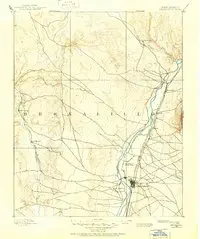
- USGS 1:125000-scale Quadrangle for Bernalillo, NM 1888 — U.S. Geological Survey, 1888 · Public domain (USGS)
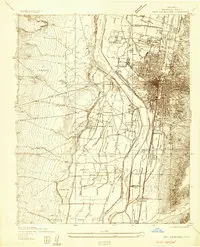
- USGS 1:24000-scale Quadrangle for West Albuquerque, NM 1934 — U.S. Geological Survey, 1934 · Public domain (USGS)
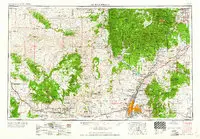
- USGS 1:250000-scale Quadrangle for Albuquerque, NM 1958 — U.S. Geological Survey, 1958 · Public domain (USGS)
- History of the KiMo — City of Albuquerque — City of Albuquerque
- New Mexico: State of spooks (A. Burnham & D. Guerrero, 26 Oct 2017) — Santa Fe New Mexican — Santa Fe New Mexican
- Official website
- Wikipedia article — Wikipedia · CC BY-SA 4.0
Text written by AI from the sources above and checked by a separate AI fact-check (how we work). Images: credits and licenses under each picture.
Spotted a mistake? Report an error