
Haunted place · Michigan, United States
Eloise
Updated November 20266 sourcesHow to visit
- As seen on Portals to Hell
- 2 archive documents
A Michigan county poorhouse and psychiatric hospital, 1832 to the 1980s; the ghost reputation we could trace is 21st-century and largely commercial.
The story
Eloise began as a county poorhouse. On 8 March 1832 Wayne County voted to create the Wayne County Poor House, first located in the Detroit area (Tales of Eloise, a local history site we read, and S. M. Keenan’s History of Eloise, 1913). On 11 April 1839, 35 people were moved to Nankin Township, now part of Westland, to the former Black Horse Tavern (Wikipedia; Keenan, citing the register). Keenan gives deeds of 22 February 1839 for two farms of 160 and 120 acres, 280 in all; Wikipedia dates the 280-acre purchase to 1834. Tales of Eloise says that on 22 March 1841 the first person was registered as “insane”: Bridget Hughes. Keenan dates the first distinction the same way and says the register’s word was “crazy.”
The institution grew with the region. A brick asylum building went up in 1868. On 20 July 1894 a post office named Eloise opened. Keenan explains the name: the board chose it for the four-year-old daughter of its president, Freeman B. Dickerson, a recent postmaster of Detroit. Wikipedia names her as Eloise Dickerson Davock. The name Eloise Hospital was adopted on 18 August 1911. Keenan counts 576 patients in the asylum on 25 June 1913, Tales of Eloise gives 1,700 by 1923, and Wikipedia gives about 10,000 residents at the peak during the Great Depression. The complex was largely self-sufficient, with its own fire and police services, a railroad and trolley system, a bakery, laundry, post office, power plant and farm (Wikipedia). It also housed what Wikipedia calls the first kidney dialysis unit in Michigan and used music therapy, alongside hydrotherapy and shock and insulin treatments. The inventor Elijah McCoy was a patient in the infirmary for a year before his death.
The last burial in the hospital cemetery is said to have taken place in January 1948 (Tales of Eloise). A 1945 publication is titled The Patient: Wayne County General Hospital, a later name of the institution; we could not open it. The psychiatric division began closing in 1977, and Tales of Eloise says the last psychiatric patient left in 1979. Wikipedia gives 1982 for the final transfers and 1986 for the closing of the general hospital. We have not been able to settle these dates. Tales of Eloise says 7,145 former residents are said to be buried in the cemetery; we could not check that figure.
The legend
Wikipedia says the site and its cemetery are reputed to be haunted, citing a 2010 book by Baldassarro R. Wolf and a 2014 piece on the Haunting America site, neither of which we read. We found no named ghost and no dated early witness. The sources we read that describe a haunting are all from the 21st century, and many are commercial: tours, an escape game and television series.
The media record is easy to date. Portals to Hell covered Eloise in an episode dated 16 April 2022, Ghost Brothers: Lights Out in season 1, episode 2 (“Dead and Forgotten”), and Expedition X in two parts released on 9 August 2023. A horror film titled Eloise appeared in 2017. None of these is evidence about the people who lived and died in the institution, and we will not retell their claims as fact.
Something else worth separating is the real history. Steve Luxenberg’s Annie’s Ghosts (2010), described by Wikipedia, is about the author’s aunt, kept secret by the family, who was committed to Eloise in the 1940s; as described, it concerns his family rather than a haunting. We searched the Internet Archive text of Keenan’s History of Eloise (1913), an institutional history, and found no mention of a ghost or a haunting in it. The local newspaper archive we searched for “Eloise” returned only unrelated text, mostly the given name. We found nothing early that links the place to ghosts.
What remains today
Only part of the complex survives. Wikipedia says the Kay Beard Building still stands and was used by the county until 2016, the former commissary is now a family homeless shelter and, as of June 2025, the firehouse shell has been restored for storage and the power plant is slated for demolition because of structural damage. The rest of the land has become a shopping center, a golf course and housing. A smokestack was demolished in 2006, and arson heavily damaged the bakery in April 2016. We could not confirm who owns the property now.
Visiting
We could not confirm the current access rules, and at least one surviving building has structural damage. According to Wikipedia, the site now offers history tours, haunted-house attractions and escape rooms; we have not verified current dates, prices or what the tours cover. Please check with the site or the county before making plans, and respect the fact that this was a place where very many people lived, were treated and died. The cemetery is a burial ground and should be treated as one. Status as of our research in November 2026.
Old maps
Investigated on TV
- Portals to Hell · Season 3, episode 2 — “Eloise Psychiatric Hospital”2022
Where it is
The circle shows the general area only. Open on the full map
Sources
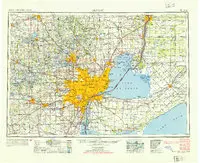
- USGS 1:250000-scale Quadrangle for Detroit, MI 1954 — U.S. Geological Survey, 1954 · Public domain (USGS)
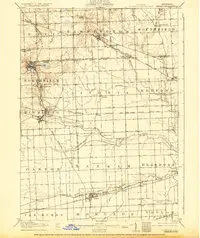
- USGS 1:62500-scale Quadrangle for Plymouth, MI 1905 — U.S. Geological Survey, 1905 · Public domain (USGS)
- History of Eloise; Wayne County House, Wayne County Asylum (S. M. Keenan, 1913), full text — Internet Archive, 1913
- Portals to Hell — Wikipedia
- Wikipedia article — Wikipedia · CC BY-SA 4.0
- Written History — Tales of Eloise
Text written by AI from the sources above and checked by a separate AI fact-check (how we work). Images: credits and licenses under each picture.
Spotted a mistake? Report an error