
Haunted place · Washington, United States
Butterworth Building
Updated November 20267 sourcesHow to visit
- Protected heritage
- 4 archive documents
Seattle's first purpose-built mortuary, beside Pike Place Market, now home to Kells Irish pub, whose ghost stories hinge on a disputed embalming room.
The story
The Butterworth Building stands on First Avenue at the edge of Seattle's Pike Place Market, built into such a steep slope that it shows three stories to the avenue and five to Post Alley behind it, according to Wikipedia (the nomination gives two and four). It was designed by the architect John Graham Sr. for Edgar R. Butterworth, and the 1971 National Register nomination calls it Graham's first commercial commission in Seattle. Butterworth & Sons moved in in 1903.
Its owner had an unusual path into the funeral trade. Born in Massachusetts in 1847, Edgar Butterworth trained as a lawyer, then moved west with his family by way of Minnesota, St. Louis and Fort Scott, Kansas, reaching Chehalis in Washington Territory in 1881, where he put up the area's first steam-powered flour mill. In 1882 he opened a small furniture store in Centralia and, during an outbreak of diphtheria, began stocking ready-made coffins. That sideline became his career. He sat on Centralia's first city council, served as mayor and spent two terms in the state legislature before moving to Seattle in 1892 and buying control of an existing undertaking firm. The nomination credits him with popularizing the words "mortuary" and "mortician" and with running the earliest hearse anywhere north of the Columbia.
The First Avenue building was Seattle's first structure designed from the ground up as a mortuary, a one-stop operation that, in a 2009 radio description by Jeannie Yandel, covered everything "from corpse retrieval to coffin sales." It reportedly boasted the West Coast's first elevator, used to carry bodies between floors. A Seattle Mail and Herald piece of August 1904 praised it as "the most complete establishment of its kind in the United States." Expense was no object: the interiors used stained mahogany, clear and colored art glass, ornamental plaster, pressed tin and custom brass and bronze hardware. Stables and hay storage occupied the alley level.
The business outgrew the building in the 1920s (1923, according to Wikipedia) and moved to a new site, about the time horse-drawn funeral processions disappeared. The Volunteers of America bought the building, which slowly lost its polish until a sale in the 1960s led to a careful rehabilitation. It was listed on the National Register in 1971 and lies within the city's own market historical district as well as the federal Pike Place Public Market Historic District.
The legend
A former funeral home beside Pike Place Market was always going to attract ghost stories, and Wikipedia notes that several are attached to the building. They center on the basement, which opens onto Post Alley and has housed Kells Irish Restaurant & Pub since at least 2009. The popular version holds that the pub occupies the old embalming room and crematorium, and that the dead processed there have never fully left.
That premise is shaky. Wikipedia points out that the August 1904 Seattle Mail and Herald description, written just after the building opened, places the heating plant, stables and storage for funeral wagons in the basement, not embalming or cremation. The 1971 nomination likewise puts stables and hay storage at alley level. So the claim that drinkers sit where bodies were embalmed appears to be a later embellishment.
The ghost stories reached print in Stuart Eskenazi's "Ghost stories haunt Pike Place Market" in the Seattle Times on June 13, 2008, and in Jeannie Yandel's KUOW-FM piece "Seattle's Coziest Embalming Room" on Halloween 2009. Wikipedia cites both; the originals are gone and the archived copies could not be read for this page, and our sources do not confirm which specific ghosts they describe, so the named spirits told on Pike Place ghost walks are left out here. The building's highest-profile moment came on Ghost Adventures Season 4, Episode 14, "Kell's Irish Pub Restaurant," aired December 17, 2010, which framed the haunting around the building's past as an undertaker's that collected corpses. In short: a real and fascinating funeral history, a disputed basement backstory, and ghost reports that remain vague in our sources.
What remains today
The brick building survives with only slight alterations from its original look, according to the 1971 survey, which praised its woodwork, colored glass, pressed tin and bespoke metal hardware. The upper floors face First Avenue, while the alley side shows the full height of the building and an opening in the wall that was presumably the vehicle entrance in mortuary days. Kells occupies the lower level, entered from Post Alley.
Visiting
Kells Irish Restaurant & Pub is open to the public, so the easiest legal way inside is to stop for a meal or a pint. The upper floors are private, so stick to the public areas. The exterior can be seen from First Avenue and from Post Alley as part of a walk through Pike Place Market. Several Pike Place ghost tours are known to include the building; book a guided walk if you want the stories told on site, and keep in mind the doubts about the embalming-room tale.
Photographs


From the archives


Old maps
Where it is
The circle shows the general area only. Open on the full map
Sources
- National Register nomination #71000873 (texte intégral) — U.S. National Park Service · Public record
- National Register of Historic Places file (NRHP #71000873) — U.S. National Park Service · Public domain (U.S. government)
- Wikimedia Commons category : Butterworth Building — Wikimedia Commons
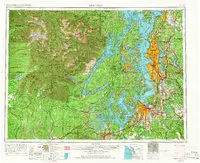
- USGS 1:250000-scale Quadrangle for Seattle, WA 1958 — U.S. Geological Survey, 1958 · Public domain (USGS)
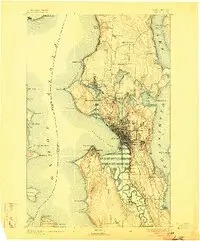
- USGS 1:62500-scale Quadrangle for Seattle, WA 1894 — U.S. Geological Survey, 1894 · Public domain (USGS)
- "List of Ghost Adventures episodes" — Wikipedia — Wikipedia
- Wikipedia article — Wikipedia · CC BY-SA 4.0
Text written by AI from the sources above and checked by a separate AI fact-check (how we work). Images: credits and licenses under each picture.
Spotted a mistake? Report an error