
Haunted place · England, United Kingdom
Berry Pomeroy Castle
Updated November 202620 sourcesHow to visit
- Protected heritage
- 4 archive documents
Ruined castle and Tudor mansion in South Devon, abandoned around 1700 and said to be haunted by a White Lady and a Blue Lady, legends shaped by a Gothic novel.
The story
Berry Pomeroy Castle lies near Berry Pomeroy, a village in the South Hams district of South Devon. It is really two buildings in one: a castle raised by the Pomeroy family, and the shell of a grand Tudor mansion built later inside its walls.
The Pomeroys had held the land since the eleventh century, in the generations after the Norman Conquest, and for a long time the castle was assumed to be equally ancient. Archaeology tells a different story. Extensive excavations between 1980 and 1996 showed that the Pomeroys only began the castle in the later fifteenth century, on a fresh site within their deer park; Wikidata gives 1496 as its starting date. Older claims, still repeated on some ghost websites, that it was built in the thirteenth century by a Henry de Pomeroy are now considered outdated.
The family did not keep it long. By 1547 the Pomeroys were in financial difficulty and sold the estate to Edward Seymour, 1st Duke of Somerset, one of the most powerful figures of Tudor England, who probably never even visited. After his execution the property was briefly forfeited to the Crown before returning to the Seymours, who poured money into a lavish mansion within the old walls, begun in the 1560s, extended by about 1590 and still unfinished in 1613. That splendor was brief. In the late seventeenth century the fourth Seymour baronet moved his household to Wiltshire, and by about 1700 Berry Pomeroy had been abandoned.
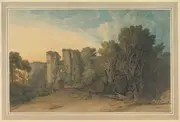
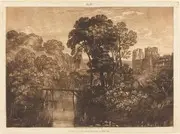
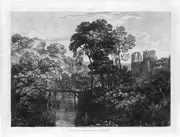
For a century it crumbled, becoming an ivy-choked ruin full of jackdaws. Then taste changed. At the end of the eighteenth century the fashion for the "picturesque" turned ruins like this into prized scenery, and artists and tourists began to arrive. A catalog of Devon topographical prints compiled by J. V. Somers Cocks lists 45 engravings of the castle, the earliest a 1734 London view by the brothers Samuel and Nathaniel Buck, the latest an Exeter print of 1861. Through the nineteenth century the castle became a popular excursion, and it has remained one ever since, helped along by its ghosts.
The legend
The English Heritage guidebook, quoted by Wikipedia, calls Berry Pomeroy "reputed to be one of the most haunted castles in Britain," and its managers today market it as "the most haunted castle in Devon." Two women dominate the legends, and their stories are often tangled together.
Legend names the White Lady as Margaret Pomeroy, or Mary in some versions. According to the tale, her sister Eleanor, jealous of her beauty, shut her in the so-called dungeon under St Margaret's Tower and left her to starve. Witnesses describe her emerging from the tower to walk the ramparts, occasionally waving at people below; the Mysterious Britain website gives 1987 as the most recent sighting it knows of.
The Blue Lady is darker. Tradition makes her the daughter of a Norman lord, made pregnant by her own father, after which the baby was strangled, by her or by him depending on the version. She is said to beckon passers-by toward her tower, where in some tellings they lose their way and in others they fall to their deaths, and she has been described as a death omen for whoever lived at the castle. Other stories add two Pomeroy brothers who supposedly spurred their horses over the walls sooner than give themselves up, a leap marked by reported screams and thuds, as well as a Cavalier soldier, a lady in grey and unexplained lights and shadows.
The oldest known ghost account dates to the late eighteenth century. The physician Sir Walter Farquhar, who received a baronetcy in 1796, was reportedly called to treat the sick wife of the castle's steward. While waiting, he saw a richly dressed and visibly distressed woman climb a staircase. The steward told him it was the baron's daughter who had strangled her child, and that her appearance foretold a death; his wife died soon afterward. The account was later printed in John Ingram's collection The Haunted Homes and Family Traditions of Great Britain. Skeptics point out that by Farquhar's time the castle was already largely a ruin, which makes the oak staircase and paneled room of the story hard to place.
Much of the lore may owe more to fiction than to history. In 1806 a Gothic novel, The Castle of Berry Pomeroy, published under the name "Edward Montague," told a tale of jealousy, murder and ghostly revenge at a castle then thought to date from Norman times, and it was reprinted in Victorian times. English Heritage links the site's ghostly image to romances of this kind. One writer argues that the jealous-sister plot comes straight from the novel, and that the brothers' leap was borrowed from a St Michael's Mount legend, noting that the castle was never besieged. A Torbay Weekly columnist has observed that no record exists of the Pomeroy sisters named in the legend. The excavations' finding that the castle was built in the fifteenth century also undermines the "Norman lord's daughter," and one source suggests the tower's "dungeon" was in fact a gun position.
Television has visited too. The live series Most Haunted Live! spent the third night of its "Terror in Torbay" run at the castle, broadcast on March 14, 2005 (listed as Season 4, Episode 3), fronted by Yvette Fielding with the medium Derek Acorah. The skeptic site BadPsychics later accused the production of briefing Acorah about the location beforehand and of staging theatrical collapses; Acorah denied any prior knowledge, and the claims rest on that single source. In 1983 the ghost author Peter Underwood recorded a vigil at which a clairvoyant claimed to sense a small girl, whom she identified as a Pomeroy child born out of wedlock. A gentler tradition also survives: a beech in the grounds was once a wishing tree, where you whispered your wish against the trunk and walked backward around it several times.
What remains today
The ruin combines the gatehouse and curtain walls of the fifteenth-century castle with the tall, roofless shell of the Seymour mansion inside them, including St Margaret's Tower, the focus of the White Lady story. The site is protected both as a scheduled monument and as a Grade I listed building, and it is cared for by English Heritage. Its audio guide tells the ghost stories alongside the history.
Visiting
Berry Pomeroy Castle is managed by English Heritage and opens seasonally; check the English Heritage website for current dates, hours and prices before traveling. The audio tour covers both the history and the legends. No regular official ghost tour was found, and any paranormal night held there would need to be arranged through the site's managers, so never enter the ruin after hours.
As with any ruin, stay within the marked areas, watch your footing on uneven ground and do not climb the masonry. The castle sits in rural South Devon near Berry Pomeroy village, within easy reach of Totnes and the Torbay coast.
The ghosts
The Blue Lady
Said to be Said to be the daughter of a Norman lord who bore her father's child (undermined by the castle's 15th-century date)
She beckons visitors toward her tower, where they get lost or fall, and is considered a death omen. Physician Sir Walter Farquhar is said to have seen a distressed, richly dressed woman on a staircase before the steward's wife died.
- Apparitions
First reported: Late 18th century (Sir Walter Farquhar's account). Reported by: Sir Walter Farquhar (via John Ingram, Haunted Homes)
The Cavalier
A Cavalier soldier is among the other figures reported at the castle. No details are recorded.
- Apparitions
Reported by: Totnes Times; Mysterious Britain
The lady in grey
A lady in grey is listed among the castle's lesser ghosts, without further detail.
- Apparitions
Reported by: Totnes Times; Mysterious Britain
The little girl
Said to be Said by a clairvoyant to be an illegitimate Pomeroy child
During a 1983 ghost watch recorded by Peter Underwood, a clairvoyant described a little girl at the castle.
First reported: 1983. Reported by: Peter Underwood, Nights in Haunted Houses
Family member
The Pomeroy brothers
Said to be Two Pomeroy brothers said to have ridden off the ramparts rather than surrender
Screams and thuds are reported at 'Pomeroy's Leap'. The castle was never besieged, and one writer suggests the story was borrowed from St Michael's Mount.
- Screams
Reported by: Mysterious Britain; Weird Wiltshire (weak)
The White Lady
Said to be Said to be Margaret (or Mary) Pomeroy, starved by her jealous sister Eleanor; no record of these sisters exists
Said to have been imprisoned and starved by her sister in the dungeon below St Margaret's Tower, she is reported rising onto the ramparts and sometimes waving at visitors. One writer traces the jealous-sister plot to the 1806 novel The Castle of Berry Pomeroy.
- Apparitions
Reported by: Mysterious Britain (sighting dated 1987); English Heritage
Photographs


From the archives

Where it is
The circle shows the general area only. Open on the full map
Sources
- Historic England list entry (List entry 1017855) — Historic England · Open Government Licence
- Berry Pomeroy Castle — Internet Archive · Joseph Mallord William Turner, 1816-01-01 · Public domain (pre-1929)
- Berry Pomeroy Castle, from Liber Studiorum, part XII — Internet Archive · Joseph Mallord William Turner, 1816-01-01 · Public domain (pre-1929)
- Berry Pomeroy Castle in the County of Devon — Internet Archive · Francis Towne, 1775-01-01 · Public domain (pre-1929)
- TREE-RING ANALYSIS OF OAK TIMBERS FROM BERRY POMEROY CASTLE, NEAR TOTNES, DEVON, 1992 — Archaeology Data Service via Europeana · http://rightsstatements.org/vocab/InC-EDU/1.0/
- WALL PAINTING CONDITION AUDIT, BERRY POMEROY CASTLE, DEVON — Archaeology Data Service via Europeana · http://rightsstatements.org/vocab/InC-EDU/1.0/
- Wikimedia Commons category : Berry Pomeroy Castle — Wikimedia Commons
- Berry Pomeroy Castle — Central Library of Zurich via Europeana · http://creativecommons.org/publicdomain/zero/1.0/
- "Berry Pomeroy Castle and its many, many ghosts" (30 Nov 2024) — Weird Wiltshire — Weird Wiltshire (blog, weak source
- "Berry Pomeroy Castle – Haunted History" — Higgypop (paranormal directory) — Higgypop (paranormal directory, leads only
- "Berry Pomeroy Castle" (with Ian Topham's 2010 comment quoting Ingram 1897) — Mysterious Britain & Ireland — Mysterious Britain & Ireland (enthusiast site
- Bilden visar huvudingången till slottsruinen Berry Pomeroy Castle nära Dartmouth i England. De två torn som skyddar porten är helt täckt med murgröna. — Naval Museum via Europeana · http://creativecommons.org/publicdomain/mark/1.0/
- "Derek Acorah and Berry Pomeroy incident" (Jon Donnis, 16 Sep 2007) — BadPsychics (sceptic blog) — BadPsychics (sceptic blog
- "Discover the grim history of the castle rumoured to be haunted by wronged women" (Chloe Shakesby, 5 Oct 2022) — Totnes Times — Totnes Times
- "History of Berry Pomeroy Castle" — English Heritage — English Heritage
- "Kevin Dixon: Historic gem, paranormal folly?" — Torbay Weekly (not read directly) — Torbay Weekly (search excerpt only
- "Most Haunted Live! – Terror in Torbay (3)" — TheTVDB — TheTVDB
- Official website
- print (etching and mezzotint): ["Raglan Castle"] from Liber Studiorum aka ["Berry Pomeroy Castle"] — Nottingham City Museums and Galleries via Europeana · http://creativecommons.org/licenses/by-nc-sa/4.0/
- Wikipedia article — Wikipedia · CC BY-SA 4.0
Text written by AI from the sources above and checked by a separate AI fact-check (how we work). Images: credits and licenses under each picture.
Spotted a mistake? Report an error